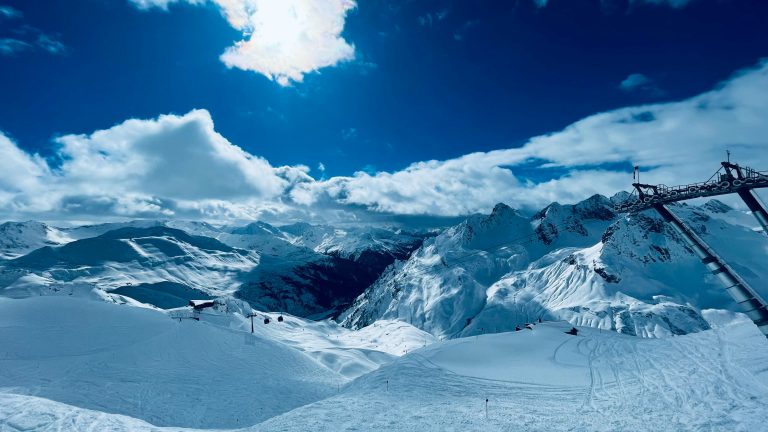
Tignes or Val d’Isère? Choosing Your French Alps Ski Base
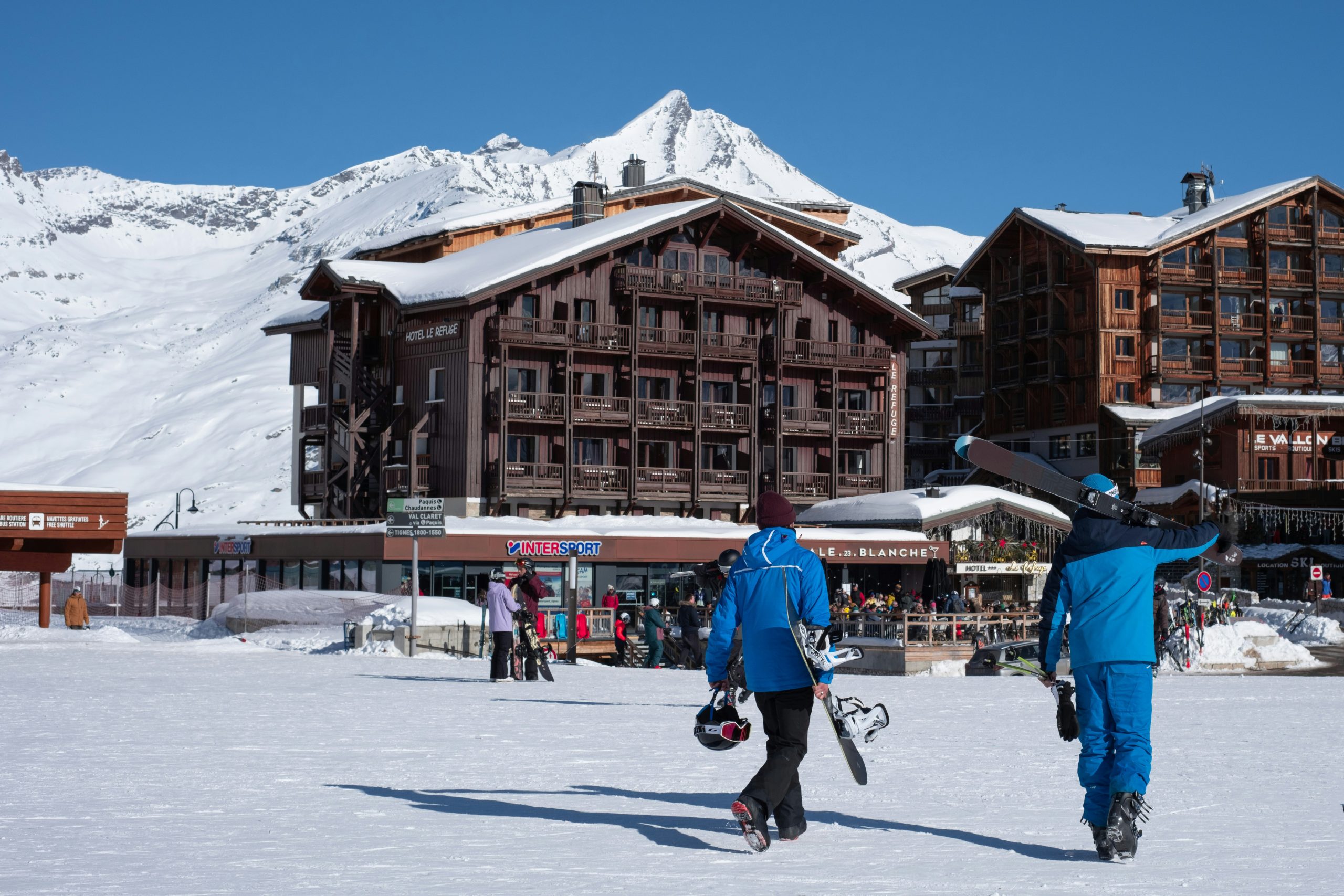
Choose Tignes Le Lac or Val Claret when upper Tignes access and an apartment-led ski week are the priorities. Choose Val d’Isère Centre for Solaise skiing and walkable village evenings, or La Daille for Bellevarde-side access and coach arrival.
Neither resort name alone determines the better booking. Both access the linked Tignes-Val d’Isère domain, marketed as 300 km of pistes, when the relevant lifts and connections operate.
This Tignes vs Val d’Isère comparison is for experienced mountain vacationers choosing a five- to seven-night base. The useful questions are where the group starts, how developing skiers return, and what passes, lessons and a shared apartment cost for the same week.
| Base | Best fit | Main friction | First useful lift or learner area |
|---|---|---|---|
| Tignes Val Claret | High-mountain skiing and adults wanting lively evenings | Exact apartment position and return route | Perce-Neige for Grande Motte; Bollin learner area |
| Tignes Le Lac | Mixed groups wanting one central meeting hub | Different blocks can mean different walks | Tovière or Palafour; Almes and Rosset learner lifts |
| Tignes 1800 / Les Boisses | Families choosing lessons in the same village | Extra uplifts for the upper domain | Boisses gondola and local learner area |
| Les Brévières | Village-oriented stays and local ski days | Lower return terrain and onward transport | Brévières gondola toward 1800; Grande Pareï learner lift |
| Val d’Isère Centre | Mixed groups, Solaise days and walkable evenings | Centre does not mean next to the lifts | Solaise or Olympique; village snow front |
| La Daille | Bellevarde-side skiing and coach arrival | Bus or walk for central dining | Daille gondola and Lanches learner lift |
| Le Fornet | Quiet base with Iseran-side priorities | More movement for Centre and Tignes days | Fornet cable car toward Iseran |
Use the table to narrow the village, then map the actual property. A good-looking resort-wide price can conceal a poor daily route.
Which village actually fits your week?
The best base keeps the least flexible traveler close to useful terrain. That may be a child’s lesson point, an adult’s manageable return, or a non-skier’s access to services.
Tignes Val Claret and Le Lac
Val Claret is the first village to test for Grande Motte access via the Perce-Neige funicular. It also has the Bollin learning area, so it should not be treated as an advanced-only base.
Le Lac is the better starting point for a central mixed-group hub. Palafour and the Tovière gondola are key departure points; use the current Tovière name when checking maps and accommodation directions.
The official Tignes village guide distinguishes Le Lac’s central services from Val Claret’s sport and evening emphasis. Travelers wanting quiet should check the building’s position relative to bars, rather than assuming every apartment has the same atmosphere.
Map the door-to-lift walk, stairs, rental shop, storage and groceries. A slope-adjacent apartment may still involve carrying equipment across a plaza.
Le Lavachet is another Tignes 2100 neighborhood to recognize in listings. Check its local lift and shuttle access before treating a “Tignes 2100” address as Le Lac or Val Claret.
Tignes 1800 and Les Brévières
Tignes 1800, also called Les Boisses, has its own beginner area and Boisses gondola. It offers mountain access by lifts; a shuttle is not automatically required for every ski morning.
Les Brévières is the lower village at about 1,550 meters. Start by checking the Brévières gondola connection toward 1800, and check the current map for onward lifts.
These bases suit groups happy to organize the week around their local departure and lesson points. They are weaker choices when adults must repeatedly return to Le Lac for a child’s pickup.
Tignes describes separate shuttle circuits for 2100, 1800 to 2100, and Brévières to 1800. A trip between the lower village and an upper base may therefore involve a change.
The published mobility page currently shows off-season information and summer schedules, not a usable winter 2026 to 2027 timetable. Do not apply those departure times to a January stay.
Val d’Isère Centre, La Daille and Le Fornet
Centre is the first choice to test when Solaise, the main snow front and walkable evenings matter. Solaise and Olympique serve different mountain sectors, so measure the walk to the lift the group actually needs.
La Daille suits a Bellevarde-oriented week and contains the coach station. Its lift access does not mean every property is convenient for a lesson starting in Centre.
Le Fornet suits travelers prioritizing the Iseran side and quieter evenings. It adds movement when the day revolves around Centre, Bellevarde or the Tignes link.
The free Val shuttle network connects the districts, but the exact stop, final departure and walk back still matter. Skip an outlying property if the group wants frequent independent returns to the accommodation.
Skiing together: progression, advanced terrain and link friction
A large linked map is useful only when the group’s actual routes work. Keep local progression separate from an adult’s wish to explore the whole domain.
Developing skiers and a practical return
Tignes lists free learner lifts including Bollin at Val Claret, Almes and Rosset at Le Lac, and beginner facilities in 1800 and Les Brévières. These are useful anchors for selecting lessons and lodging.
For confident blue-run skiers, the operator’s Tignes material names Anémone on Palafour and Henri on Tovière as blue pistes. Treat them as candidates to assess locally, not a promise of easy snow or an uncomplicated village return.
Val d’Isère offers village-level learning at Savonnette and Village, plus Lanches at La Daille. Its Solaise sector has green and blue terrain, including the Madeleine green run.
The important Val distinction is between gentle skiing at altitude and the descent to the village. The official live map page identifies Solaise and Olympique as download options.
Downloading can be the planned return, rather than a last-minute rescue from a piste the developing skier cannot manage. Confirm the lift’s downward operation and closing time that morning.
Do not recommend an “easier black” from its color alone. A red-run skier considering a black needs a current assessment of steepness, grooming, bumps, surface and fatigue.
Lessons or skiing together
Book the exact school, age group, language, level, meeting point and pickup before choosing nonrefundable lodging. “ESF Tignes” is insufficient if the lesson is in another village.
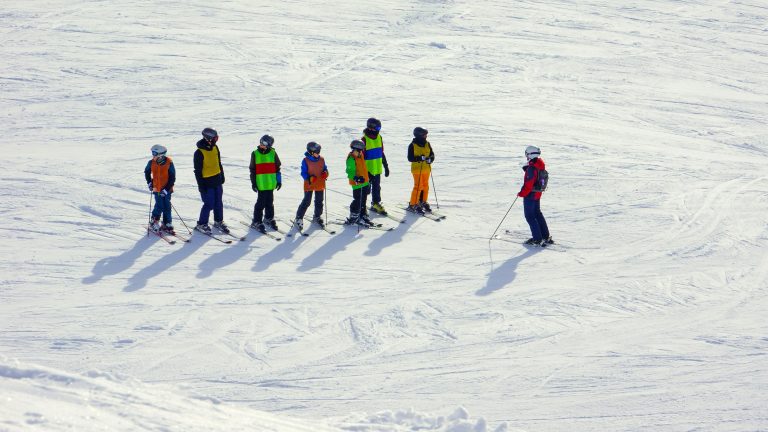
Group lessons can give developing skiers a structured progression while adults ski independently. The cost is a fixed start and pickup, which makes distant-sector excursions less flexible.
Skiing together works when the stronger skiers willingly stay within the least confident skier’s limits. A private lesson is another option to quote when the group needs a specific schedule or targeted progression.
Ask whether the lesson price includes equipment, lunch or a lift pass. Confirm those items directly; do not assume a free beginner lift removes every pass requirement.
For families, the kids ski school cost guide provides wider context. The local meeting point remains more important than a country-level lesson-price comparison.
Advanced skiing and the connection
Val Claret favors Grande Motte departures; Centre favors Solaise or Bellevarde; Le Fornet favors Iseran-side starts. That is an access comparison, not a claim that advanced skiers cannot use the other sectors.
Before crossing the Tignes-Val link, identify every outbound and return lift and the final permissible return time on the current operator map. Do not plan a cross-resort lunch if lesson pickup depends on an uncertain connection.
Separate open managed pistes from marked ungroomed terrain and uncontrolled off-piste. Follow the current map legend and closures rather than treating all black markings as groomed runs.
An off-piste plan needs qualified local guidance, appropriate skills and equipment, and current mountain weather and the Météo-France avalanche bulletin for the relevant massif. An open lift does not establish safe adjacent terrain.
Local advanced piste skiing is the alternative when the group cannot support that assessment. This guide does not prescribe an off-piste itinerary.
What the same ski week really costs
For January 16 to 23, 2027, the two bases are essentially even on cost for an apartment, ski passes and one adult group course. Choose the village around the skiing, lesson location and evenings you want. This example covers four adults aged 19 to 64 sharing an apartment for seven nights, with all four skiing and one taking lessons.
| Cost for the group | Tignes | Val d’Isère |
|---|---|---|
| Four adult linked ski passes ($531 (€468) each; 6 = 7 days) | $2,126 (€1,872) | $2,126 (€1,872) |
| One adult ESF group course | $298 (€262) | $459 (€404)* |
| Average seven-night apartment cost, sleeps four | $1,759 (€1,549) | $1,679 (€1,479) |
| Total: passes + one course + apartment | $4,182 (€3,683) | $4,264 (€3,755)* |
Planning estimates checked September 30, 2026. The Val lesson allowance uses ESF Centre’s advertised starting price for five or six three-hour afternoon sessions; Tignes Le Lac’s $298 (€262) pack includes six 2.5-hour sessions. These are different weekly packages, so compare teaching time as well as price. The total excludes meals, equipment hire, transport, insurance and accommodation extras charged separately.
How the apartment averages were calculated
The averages are arithmetic means of three published accommodation-only rates in each destination for the exact seven-night dates, rounded to the nearest euro. They describe this small sample of apartments sleeping four, rather than the whole rental market.
In Tignes, the sample comprises Plein Soleil in Val Claret at $1,537 (€1,354,) Divaria in Le Lac/Lavachet at $1,930 (€1,700,) and Kalinda in 1800 at $1,810 (€1,594,) including its displayed promotion.
In Val d’Isère, the sample comprises Rond-Point des Pistes III at $1,298 (€1,143,) Val d’Isère Village C at $1,569 (€1,382,) and Roche de Fours at $2,170 (€1,911).
The units vary in size and amenities: the Tignes listings are two-room apartments, while the Val sample includes two-room units and the larger three-room Roche de Fours. Sleeping four may involve a sofa bed. Treat the average as a starting budget, then check the sleeping layout, useful lift, lesson meeting point and final fees for the apartment you choose.
What the difference means for your booking
Treat this comparison as a cost tie. Both bases use the same linked pass, and the apartment and lesson allowances balance out closely enough that neither has a meaningful price advantage in this example.
Choose around the daily route: the apartment’s useful lift, lesson meeting point and sleeping layout matter more than the small difference between the totals. Final fees and your chosen course can change the budget in either direction.
For your own dates, compare the final accommodation price through the Tignes booking site and Val d’Isère booking site. Check whether a lodging-and-pass bundle beats buying separately, then add equipment, meals and travel to your personal budget.
For the broader framework, see Alps vs US ski costs and Austria vs Switzerland skiing.
A realistic ski day from each base
A manageable local day often produces more skiing than a long traverse. Plan the first useful terrain, one regrouping point and the return before adding a second sector.
| Half-day plan | Departure and skiing | Regroup and return |
|---|---|---|
| Le Lac: developing skier plus confident adult | Learner practices locally near the booked lesson point; adult tests a local Palafour outing before a longer Tovière day | Meet at the foot of Tovière; return to Le Lac early enough for pickup |
| Val Centre: a shared gentler morning | Use Solaise and the open green/blue terrain selected with the instructor | Meet at Le Lounge; confirm Solaise downloading before going up |
| Separate advanced outing | Confident skiers choose their base’s local sector after checking lift/piste status | Keep the developing skier’s pickup on the same side of the domain; postpone the cross-resort excursion |
These are planning templates, not fixed itineraries or timing guarantees. Select the actual pistes with the current map, the lesson provider and the morning operating report.
On the first day, collect equipment early enough to fit boots and resolve sizing problems. Store skis near the departure point when the apartment walk would otherwise dominate the morning.
A developing skier’s pickup should not depend on adults crossing the link at the final possible moment. Keep a margin and agree on a same-village fallback.
Lunch that does not control the whole day
At Le Lac, the Tovière picnic room is at the foot of the gondola. Tignes also lists nearby restrooms, making it a useful village regrouping anchor.
In Val, Le Lounge on Solaise offers an indoor break and picnic space. This is a more flexible meeting choice than a restaurant booking that requires every skier to complete a long traverse.
For a table-service mountain lunch, verify opening, reservation, pedestrian access and the last useful return lift directly. A restaurant reachable by one adult may not be reachable by the whole group.
A short lunch near the morning sector suits groups focused on skiing. A longer shared lunch makes more sense on a deliberately local day.
Season, weather and return limits
Val d’Isère advertises winter operation from November 28, 2026 to May 2, 2027. Planned season dates do not guarantee the linked domain, a particular village return or every lift.
Tignes describes gradual sector opening and high-altitude spring skiing. Assess the elevation of the terrain and return route the group will actually use, rather than selecting from a summit number.
Check daily lift/piste status, Val webcams, the live ski map and mountain weather. Wind, visibility and snow changes can reduce the useful area even while some lifts operate.
A lower local sector is a fallback only if its conditions and openings support it. Otherwise choose a rest day.
Val’s published winter shuttle page lists approximately ten-minute daytime service between La Daille and Le Fornet. Confirm the final service for your specific stop; the daytime frequency is not a late-night guarantee.
Tignes winter frequencies remain unconfirmed in the material available for this review. Use the mobility page for the current schedule instead of assuming an old timetable still applies.
For seasonal tradeoffs, see best time to ski in the Alps.
Arrival from Bourg-Saint-Maurice without a car
Car-free arrival is practical when the final stop and property walk are planned. The train does not take travelers directly to either resort’s accommodation.
Bourg-Saint-Maurice is the rail gateway identified by Val d’Isère. Its guide quotes about 40 minutes for the onward journey, but that is a reference estimate, not a protected connection time.
Altibus identifies S82 for Val d’Isère and S83 for Tignes. Book the actual date, destination stop and luggage allowance rather than buying from a resort name alone.
La Daille contains Val’s coach station. For Centre or Le Fornet, decide whether luggage can reasonably move onward by local shuttle or whether a property transfer is worth paying for.
For Tignes, check which village the selected S83 service reaches. Do not assume every departure serves every lower and upper village in the same way.
Altibus currently states that station-departure tickets include hand luggage, one hold bag and a pair of skis or snowboard per passenger. Airport allowances vary by fare.
Wear ordinary shoes on the gateway coach: Altibus prohibits wearing ski boots on its coach routes, while distinguishing internal resort ski buses. Confirm excess or oversized baggage when purchasing.
Compare a scheduled coach, shared transfer and private transfer by the group’s complete return price. Include waiting time, ski luggage, child-seat needs where relevant, and the walk from the drop-off to the apartment.
Saturday traffic can lengthen the road leg. Allow time for delays, rental collection, keys and groceries; do not schedule a paid lesson immediately after a tight arrival connection.
The winter 2026 to 2027 gateway timetable and fare for this comparison have not been verified. The Val shuttle page also leaves the Val coach station to Tignes 1800 timetable pending.
That inter-resort service is therefore not a guaranteed backup for a closed ski link. If the return connection becomes uncertain, stay on the lodging side of the domain.
For a short trip, a central apartment or direct property transfer can be worth more than a remote lodging saving. Skip a bargain whose final connections make the first and last days impractical.
Evenings, families and non-ski days
Choose the accommodation around both the skier’s morning and the non-skier’s day. A good lift position does not automatically deliver a good evening base.
Val Centre is the first place to test for village-focused dining and independent evenings. Le Lac provides a central Tignes service hub, while Val Claret is worth considering for adults who want livelier nights.
The quieter alternatives are conditional: 1800, Les Brévières and Le Fornet suit groups happy with local options or self-catering. Check the actual restaurant, shop and shuttle schedule before assuming quiet means convenient.
Families should prioritize equipment storage, a short lesson handoff and a place to regroup indoors. A small central apartment can work better than a larger unit requiring repeated bus trips.
A rest day that works without the ski group
In Tignes, Le Lagon is an indoor pool option, while Tignespace provides indoor sports. Check winter opening, activity reservations and admission rather than importing summer hours.
In Val, the Centre Aquasportif and cinema are useful indoor candidates. Verify their operating calendar for the stay before building the day around them.
The official Val pass page lists two pool entries for eligible linked passes of six to ten days. Free under-eight passes are excluded, so families should budget separately for those children.
For a mountain outing without skis, use the pedestrian-access list and an appropriate ticket. The linked pedestrian product does not make Tommeuses accessible to pedestrians.
Do not arrange a cross-resort lunch with a non-skier on the assumption that the skier’s link also carries pedestrians. Choose a meeting point both can reach and confirm the download.
A village lunch followed by an indoor activity is a realistic storm-day alternative. Skip sightseeing lifts when weather or access limits undermine the plan.
Tignes vs Val d’Isère: choose, avoid or look elsewhere
Start with the village that solves the group’s daily constraint. The January cost example is essentially a tie, so choose around lift access, lessons and the evenings you want.
| Priority | Start with | Choose the alternative when |
|---|---|---|
| Apartment-led value | Compare Le Lac, Val Claret and 1800 quotes | A Centre or La Daille checkout total buys a better daily route |
| Lesson-focused family | The village containing the confirmed lesson point | Paying more removes repeated transport and difficult pickup |
| Grande Motte priority | Val Claret | Val-side terrain will occupy more of the week |
| Solaise and village evenings | Val d’Isère Centre | Le Lac offers the preferred skiing and a better verified budget |
| Bellevarde and simple coach arrival | La Daille | Centre’s walkable evenings matter more |
| Quieter village stay | 1800, Les Brévières or Le Fornet | Upper-domain access or frequent regrouping outweighs quiet |
| Repeated cross-resort days | Le Lac or a Bellevarde-side Val base | The group would ski more by staying local |
A shorter walk to the useful lift or lesson point can justify a higher lodging quote. A cheaper apartment with repeated transfers may deliver less skiing and a less flexible week.
Neither is the right booking for a group requiring guaranteed snow, every advertised kilometer open, or effortless beginner travel through all sectors. Consider a more compact ski area if the group will mainly use one learner zone.
For another French Alps comparison, see Courchevel vs Méribel. Compare the accommodation base and daily routes, rather than assuming every village in a large linked area offers the same holiday.
Frequently Asked Questions (FAQs)
Sources
Research checked September 29, 2026, Pacific time; apartment and lesson comparison updated September 30, 2026. Published winter prices and schedules are dated planning information, not forecasts of January operating conditions.
- Val d’Isère: 2026 to 2027 passes, prices, season and pedestrian limits
- Tignes: village guide
- Tignes: winter ski area and learner lifts
- Tignes: first-tracks product, Palafour/Tovière and blue-piste examples
- Tignes: beginner progression and village terrain
- Tignes: resort opening and Perce-Neige access
- Val d’Isère operator: Daille gondola
- Val d’Isère operator: Solaise terrain and Le Lounge
- Val d’Isère operator: Easy Skiing and return by lift
- Val d’Isère: live map and download options
- ESF Tignes Le Lac: winter 2026 to 2027 price list
- ESF Val d’Isère: advertised adult group lessons
- ESF Val d’Isère: adult course durations and published starting prices
- Tignes: shuttle circuits and current schedule notices
- Val d’Isère: winter 2026 to 2027 local shuttles and pending inter-resort timetable
- Val d’Isère: rail gateway and La Daille coach station
- Altibus: S82/S83 routes, baggage and ski-boot rules
- Tignes: family services and picnic-room locations
- Tignes: indoor bad-weather options
- Val d’Isère: visitor FAQ and indoor/non-ski options
- Météo-France: mountain-planning advice and avalanche information
Apartment sources are the six dated 321SkiVacances listings linked in the cost section. The sample uses accommodation-only rates for January 16 to 23, 2027, including displayed promotions, rather than bundled pass/rental prices or undated headline rates. Means: Tignes (€1,354 + €1,700 + €1,594) ÷ 3 = €1,549.33; Val d’Isère (€1,143 + €1,382 + €1,911) ÷ 3 = €1,478.67. Table totals use the rounded euro means and are planning estimates for the three listed items. US dollar figures use the ECB’s September 30, 2026 reference rate of €1 = US$1.1355; totals are converted after summing in euros.