Is It Cheaper to Ski in the Alps or the US? A 7-Night Cost Comparison
For the dated trips modeled here, skiing in the Alps costs less than skiing at comparable major US resorts, even after the higher transatlantic airfare. The advantage comes mainly from lodging, rentals, meals, and ski school rather than from lift tickets alone.
That is not a universal rule. An already-owned US season pass, a short trip, a strong domestic airfare, or a family that does not need lessons can move the result toward the United States. This comparison shows exactly where that break-even point falls for a seven-night trip.
Skiing in Europe vs USA: Quick Verdict
The baseline week is January 23 to 30, 2027, with six ski days and seven nights. It compares New York departures, one room for a couple, and a two-bedroom apartment for a family of four with children ages 8 and 11.
| Traveler and matched resorts | Alps baseline | US baseline | Alps difference | Best fit |
|---|---|---|---|---|
| Couple: St. Anton vs Vail | $9,252 | $12,180 | $2,928 less | Strong Alpine value even after airfare |
| Family: Hopfgarten/SkiWelt vs Keystone | $14,560 | $19,718 | $5,158 less | Largest advantage when two children need lessons |
| Couple, US pass already owned | $9,252 | $10,950 incremental | $1,698 less | US becomes competitive with cheaper lodging |
| Family, US passes already owned | $14,560 | $17,850 incremental | $3,290 less | US closes the gap, but lessons still matter |
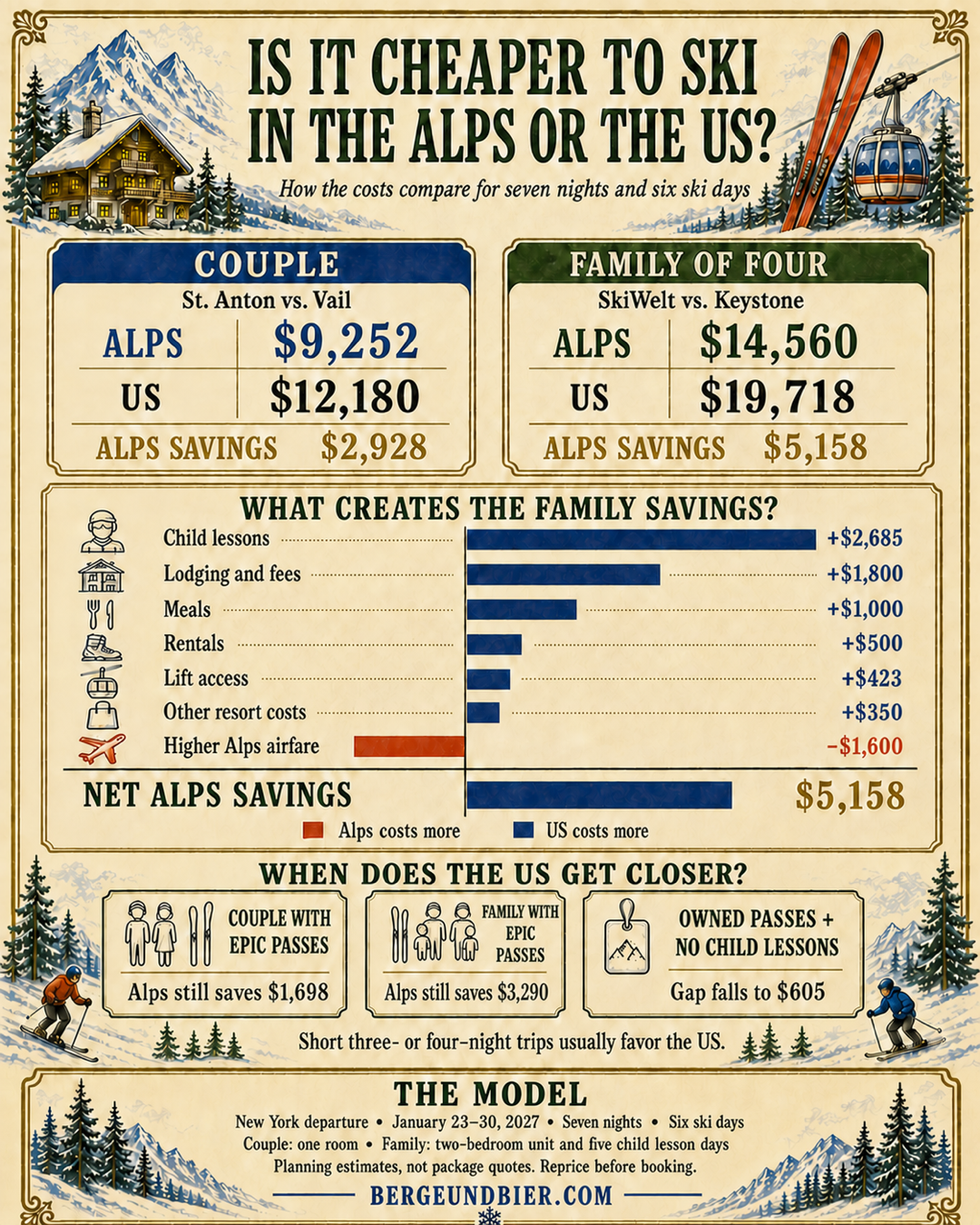
These are planning models, not promised package prices. The August 28, 2026 calculations use official 2026/27 lift and lesson prices where published, the European Central Bank reference rate published August 27 of €1 to $1.1645, and labeled allowances for flights, lodging, transfers, rentals, meals, insurance, and US lessons that still require a live checkout.
The direct answer is simple:
- Choose the Alps for a full destination week when lodging value, family ski school, food costs, and a village-based trip matter more than the easiest flight.
- Choose the US when the pass is already paid for and the group can find sensible lodging, drive or fly cheaply, and skip several days of lessons.
- Choose the US more often from the West Coast when Denver airfare is inexpensive and a transatlantic itinerary would require an extra positioning flight or hotel night.
- Do not cross the Atlantic for a three-day ski weekend. The flight time and jet lag consume too much of the trip.
- Do not assume every Alpine resort is inexpensive. Zermatt can erase the Austrian value advantage, just as Aspen can exceed the Colorado baseline.
Do not use these totals unchanged if the US trip is a drive to a regional hill, lodging is free, a pass was bought for several other trips, or one side of the comparison uses a nonrefundable teaser rate. Those are different decisions and should be modeled separately.
For the couple comparison, shortlist St. Anton accommodation around the village center and the Galzig or Rendl lifts, then compare Vail stays in Vail Village or Lionshead. These bases suit travelers who value a short daily walk and dinners without driving; an outlying room is a weaker match if its lower rate depends on extra transport.
Compare the actual route with luggage and ski boots, meal inclusions, and the all-in refundable total. A central hotel without cooking facilities also needs a different meal allowance from an apartment.
Readers choosing between European destinations should also see the detailed Austria versus Switzerland skiing comparison. Travelers who want a smaller Germany-based trip can start with the best ski resorts in Germany by month.
How the Seven-Night Cost Model Works
A fair comparison needs the same travel week, ski-day count, traveler type, and resort tier. Comparing a self-catering Austrian village with an expensive slopeside US hotel would prove very little.
Baseline assumptions
- Travel dates: January 23 to 30, 2027
- Research date: August 28, 2026
- Booking lead time: about five months
- Gateway: New York City airports, with a West Coast sensitivity later; use the lowest practical itinerary from JFK, Newark, or LaGuardia rather than forcing one airport
- Skiing: six consecutive days
- Couple: two adults sharing one room
- Family: two adults and two children, ages 8 and 11, in a true two-bedroom apartment or condo; no sofa-bed substitution is assumed
- Equipment: standard recreational skis, boots, poles, and helmets rented locally
- Meals: breakfast and several dinners prepared in the lodging, with lunch bought on or near the mountain
- Lessons: none for the couple; five days for both children in the family model
- Lodging standard: compare an all-in refundable rate with the same cancellation window on both sides; exclude nonrefundable teaser rates unless both trips use them
- Currency: €1 equals $1.1645; CHF1 equals about $1.2420 using the ECB reference table published August 27, 2026
The total formula is airfare + luggage and ski transport + airport transfer or rental car + lodging + lodging taxes and fees + lift access + rentals + lessons and lesson meals + food and gratuities + one off-slope activity + travel insurance and contingency.
Official published prices are marked as such. Planning allowances are round-number estimates designed for comparison and must be replaced with live quotes before booking. Airfares in particular can move by hundreds of dollars per person.
The US pass problem
US lift access has to be shown three ways because pass ownership can make a bad comparison look decisive:
- Epic Day Pass no longer on sale: Use a same-season lift-ticket allowance. Vail and Keystone had not published fixed January 2027 window prices when this model was researched, so this is a downside sensitivity rather than the normal booking recommendation.
- Buy a pass for this trip: Count the full current product cost. A six-day, all-resorts Epic Day Pass without peak-date access was $615 per adult and $319 per child. The modeled week does not include an Epic restricted date.
- Pass already owned: Show $0 as the incremental lift cost, but do not call the skiing free. Two current Epic Local Passes cost $1,658 for a couple; a family with two children ages 8 and 11 would spend $2,528. That economic cost belongs somewhere in the season budget.
The baseline tables use the six-day Epic Day Pass because it is the best broadly available product for someone buying lift access specifically for this trip. Buddy tickets, military products, local passes, and employer discounts are excluded because eligibility is not universal.
Audit this model in ten minutes
- Price the same dates and traveler ages on the official lift-pass sites.
- Replace each lodging allowance with the all-in refundable checkout total, including taxes, resort fees, and cleaning.
- Price the complete airport-to-door route, including parking, bags, rail or shuttle tickets, rental-car taxes, fuel, and parking.
- Run the exact lesson checkout and record hours, lunch, lift access, equipment, class rules, meeting point, and cancellation terms.
- Recalculate the total in one currency and keep both the cash-trip total and any already-owned pass cost visible.
Matching Alpine and US Resorts Fairly
The resort pairs are decision matches, not claims that the mountains have identical terrain.
| Tier | Alpine resort | US resort | Why the match works | Important limitation |
|---|---|---|---|---|
| Flagship | St. Anton am Arlberg, Austria | Vail, Colorado | Large destination resorts, strong advanced and intermediate appeal, broad dining and lodging markets | Alpine village layout and linked valleys differ from Vail’s resort structure |
| Family | Hopfgarten in SkiWelt, Austria | Keystone, Colorado | Large groomed networks, family products, ski school, apartment lodging, and manageable beginner progression | The lesson products differ in hours, lunch, class structure, and lift-access rules |
| Premium | Zermatt, Switzerland | Aspen Snowmass, Colorado | High-price international names, multiple mountain experiences, strong non-ski appeal | Zermatt is car-free and centered on one valley; Aspen Snowmass spans four mountains |
St. Anton and Vail are useful for the couple model because neither is a budget resort. SkiWelt and Keystone better expose the family cost drivers: apartment location, morning drop-off, rental handling, lesson length, and food access.
Zermatt versus Aspen Snowmass tests the upper end. It is not included in the main total because both use dynamic pricing and the January 2027 lodging and lesson checkouts were incomplete at the research date. The article uses their published pass rules as a sensitivity, not a fabricated package quote.
Couple Budget: St. Anton Versus Vail
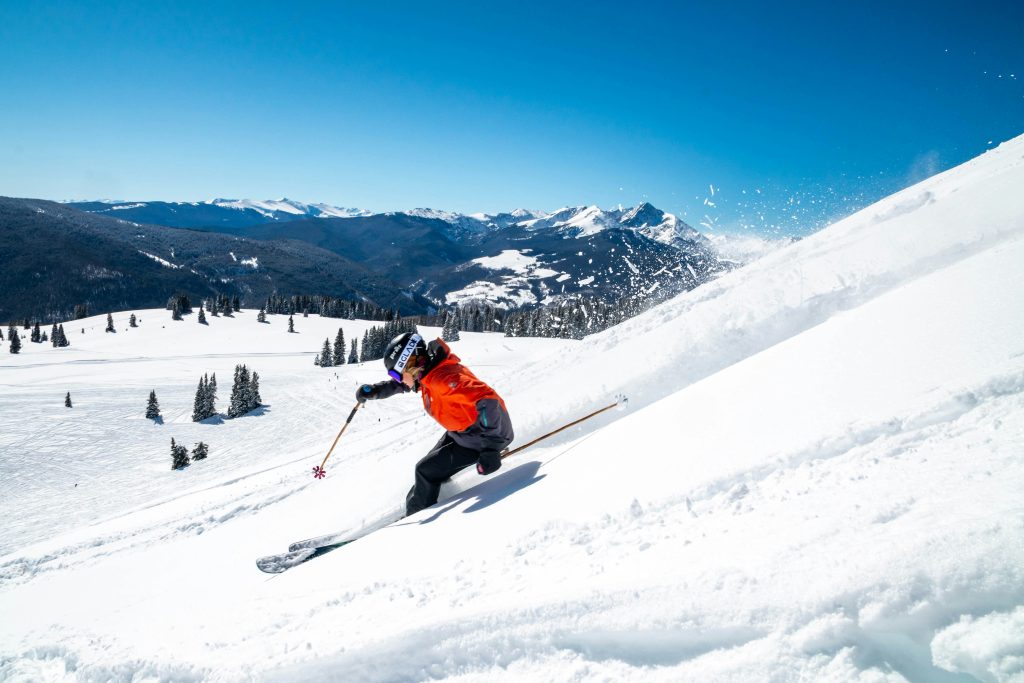
The St. Anton model wins by $2,928, or about 24 percent of the Vail total. Vail has the cheaper flight allowance, but that $800 advantage is overtaken by the all-in lodging, rental, and meal differences.
| Cost for two adults | St. Anton | Vail | Price type and note |
|---|---|---|---|
| Round-trip airfare from New York | $1,800 | $1,000 | Planning allowance; economy fares and one connection possible |
| Bags and ski-equipment transport | $250 | $250 | Planning allowance; varies by airline and what is rented |
| Airport to resort and local transport | $350 | $500 | Planning allowance; rail or shared transfer in Austria, shared shuttle or car in Colorado |
| Seven nights lodging | $2,800 | $4,550 | Planning allowance for a well-located room, not a slopeside suite |
| Lodging taxes, resort fees, and cleaning | $150 | $750 | Planning allowance; verify every checkout line |
| Six ski days | $1,102 | $1,230 | Ski Arlberg published €936 plus two €5 chip-card deposits; Epic Day Pass published price |
| Standard rentals with helmets | $500 | $850 | Planning allowance |
| Lessons or childcare | $0 | $0 | Excluded for this couple |
| Meals, groceries, and gratuities | $1,500 | $2,100 | Planning allowance with mixed self-catering and mountain meals |
| One non-ski activity | $200 | $250 | Planning allowance |
| Insurance and contingency | $600 | $700 | Planning allowance, not a policy quote |
| Total with airfare | $9,252 | $12,180 | Baseline model |
| Total without airfare | $7,452 | $11,180 | Useful for readers comparing different gateways |
Ski Arlberg lists its January 2027 six-day adult pass at €468. The price page calls the August 2026 figures provisional and says later adjustment is possible, so the final purchase page still needs a check.
Vail’s $615 adult Epic Day Pass is also time-sensitive. It was available for one to seven days and sold before the season, with prices scheduled to rise after September 7, 2026. Waiting until the travel week may replace a known pass cost with dynamic lift-ticket pricing.
Where the couple savings really come from
Lift access is nearly a draw: $1,102 in St. Anton versus $1,230 in Vail. The meaningful gap is elsewhere.
The model assigns $2,950 to St. Anton lodging and associated charges, compared with $5,300 in Vail. Meals add another $600 US premium, and rentals add $350. Those three categories create a $3,300 difference before the cheaper US airfare pushes back.
Couple break-even points
- With the $1,230 Epic Day Pass included, Vail needs to cut $2,928 from the baseline to tie St. Anton. Its all-in lodging would need to fall from $5,300 to about $2,372, or $339 per night.
- With two Epic passes already owned, Vail’s incremental total falls to $10,950. All-in lodging of about $3,602, or $515 per night, creates a tie.
- St. Anton airfare could rise from $900 to about $2,364 per person while every other assumption stayed fixed before its total matched the Vail baseline.
That last figure is not a target fare. It shows that airfare alone is unlikely to decide a seven-night trip when resort costs differ this much.
Family Budget: Hopfgarten/SkiWelt Versus Keystone
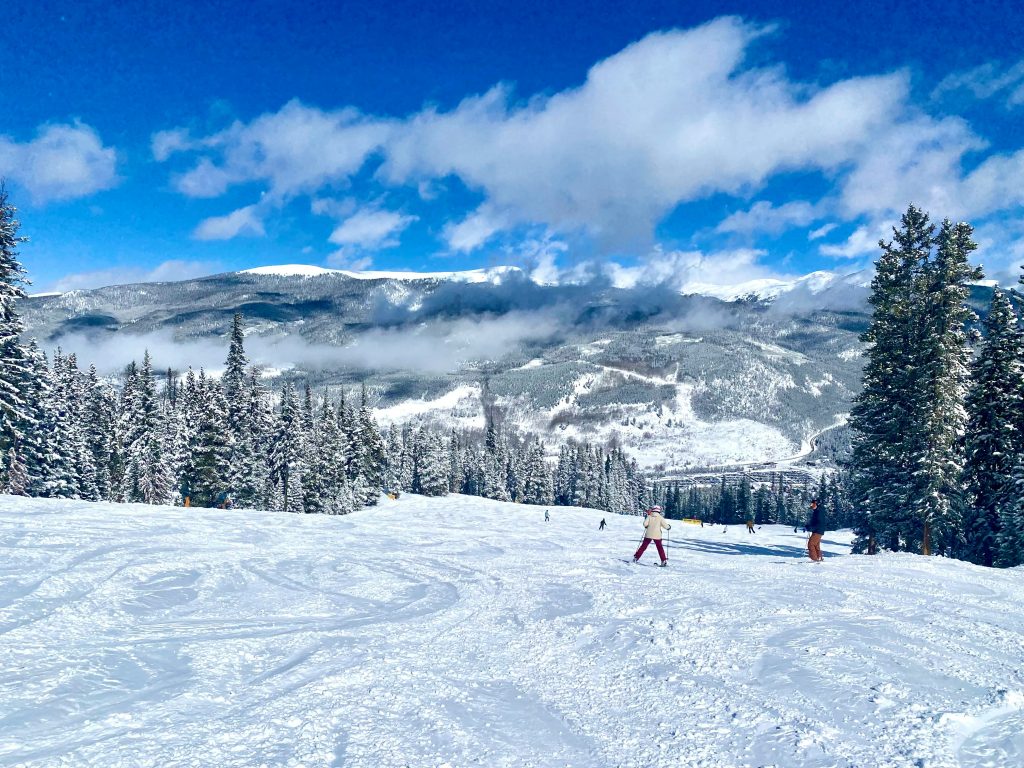
The family model produces the largest gap: $5,158, or about 26 percent of the Keystone total. Ski school is the biggest single driver, followed by lodging and meals.
| Cost for two adults and two children | Hopfgarten/SkiWelt | Keystone | Price type and note |
|---|---|---|---|
| Round-trip airfare from New York | $3,600 | $2,000 | Planning allowance |
| Bags and ski-equipment transport | $500 | $500 | Planning allowance |
| Airport to resort and local transport | $500 | $700 | Planning allowance |
| Seven nights in a two-bedroom unit | $3,200 | $4,500 | Planning allowance near a usable lift or ski bus |
| Lodging taxes, resort fees, and cleaning | $200 | $700 | Planning allowance |
| Six ski days | $1,445 | $1,868 | Published SkiWelt and Epic Day Pass prices |
| Four standard rental packages | $950 | $1,450 | Planning allowance |
| Five lesson days for two children | $815 | $3,500 | Austrian published price; US planning allowance pending live checkout |
| Meals, groceries, and gratuities | $2,200 | $3,200 | Planning allowance |
| One non-ski activity | $250 | $300 | Planning allowance |
| Insurance and contingency | $900 | $1,000 | Planning allowance |
| Total with airfare | $14,560 | $19,718 | Baseline model |
| Total without airfare | $10,960 | $17,718 | Useful for alternate gateways |
SkiWelt’s high-season six-day price is €413.50 per adult and €207 per child, or about $1,445 for this family at the stated exchange rate. The comparable six-day Epic Day Pass total is $1,868.
The Austrian lesson figure is unusually transparent. Skischule Alpin in Hopfgarten lists a five-day children’s course from age 4 at €265 per child, with lessons from 10 a.m. to noon and 1 to 3 p.m. Lunch with the instructor is €17 per day. For two children, five lesson days plus lunch total €700, or about $815.
That product has a major limitation: the school requires at least four participants or says lesson time will be halved. Keystone lists full-day child group lessons from 9 a.m. to 3 p.m., normally including lunch, and requires separate lift access and equipment unless a package says otherwise. It also advertises 20 percent off the third and later consecutive child lesson days, but the January 2027 checkout did not expose a stable price during research.
The $3,500 Keystone lesson line is therefore an explicit planning allowance, not a confirmed quote. Parents should compare the checkout total, five-day discount, included lunch, on-snow hours, class ages, ability grouping, lift access, rental bundle, drop-off location, and cancellation terms before deciding that the two products are equivalent.
Family logistics are part of the budget
A cheap apartment creates little value if each morning requires carrying four sets of equipment onto a crowded bus. Shortlist Hopfgarten accommodation against the priced lesson meeting point, then check Keystone accommodation against the base confirmed in the lesson booking; a resort name alone does not establish convenient drop-off.
A true two-bedroom unit suits families who need separate sleeping space and will cook several meals; a one-bedroom plus sofa bed does not match this model. Inspect the floor plan, kitchen equipment, laundry, bathroom count, stairs, boot storage, and the route to rentals and groceries.
A lower nightly rate is worthwhile only if added transfer, parking, and morning effort still fit the family.
Do not schedule a rigid non-ski day in advance unless the family knows it needs one. Hold one flexible afternoon for weather, fatigue, swimming, sledding, or a village walk, and verify the chosen activity close to the trip.
What changes when children skip lessons
Removing the five-day lessons lowers SkiWelt to $13,745 and Keystone to $16,218 with trip-specific passes. If the Keystone lift passes are already owned, the US incremental total falls again to $14,350.
At that point the difference is only $605. For a self-sufficient family with owned passes and a good Denver fare, Keystone may be the more rational choice despite the higher lodging and meal costs.
Premium and Pass-Ownership Sensitivities
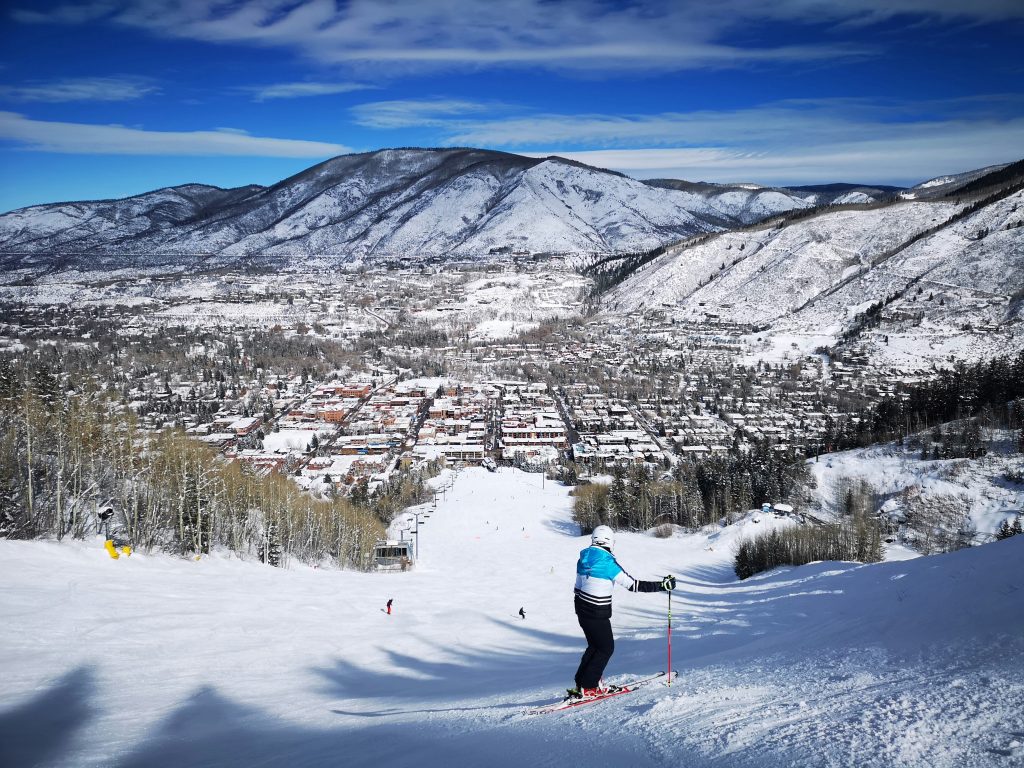
The baseline does not mean Austria beats every US resort or that Switzerland is always a poor value. Premium destinations change the calculation.
Zermatt versus Aspen Snowmass
| Decision point | Zermatt | Aspen Snowmass |
|---|---|---|
| Six-day lift access | International pass advertised from CHF432, with dynamic pricing | Full Ikon Pass provides seven combined days and was $1,449 per adult |
| Lower pass option | Zermatt-only products may reduce cost, depending on dates | Ikon Base Pass was $1,019 but provided five days at Snowmass only |
| Ground transport | Rail-based and car-free in the village | Air or road arrival, then local transport between four mountains |
| Cost warning | The advertised CHF432 is a floor, not a January quote | Buying a full Ikon Pass only for six days creates a $2,898 couple cost |
| Best reason to pay more | Matterhorn setting, car-free village, Swiss rail integration | Four distinct mountains, strong flight access through Colorado, existing Ikon value |
Neither published pass number is a complete trip price. Zermatt’s dynamic checkout must be run for the exact dates, and Aspen lodging can dominate the budget.
US lift-access scenarios
| Scenario | Vail couple lift cost | Keystone family lift cost | What it means |
|---|---|---|---|
| Epic Day Pass no longer on sale | $1,800 planning allowance | $2,800 planning allowance | Downside sensitivity only; same-season prices are dynamic and must be repriced |
| Buy six-day Epic Day Pass | $1,230 | $1,868 | Best published trip-specific baseline at research date |
| Epic products already owned | $0 incremental | $0 incremental | Cash outlay falls, but the original pass cost remains real |
| Count current Epic Local Pass economics | $1,658 | $2,528 | Useful when this is the only ski trip charged to the pass |
An Epic Local Pass provides access that works for the modeled dates, but it is not automatically cheaper than the six-day Epic Day Pass when charged entirely to one trip. A season pass becomes economically stronger when the traveler uses it on additional ski days.
East Coast, West Coast, and trip-length sensitivity
The New York baseline favors Europe more than a West Coast departure does. A planning sensitivity of $2,200 for a couple to Europe and $700 to Denver reduces the Alpine advantage by about $700. For a family, $4,400 to Europe versus $1,400 to Denver reduces it by about $1,400.
The Alps still lead in both adjusted baseline models, but owned passes can reverse the conclusion for travelers starting in California, Oregon, or Washington.
Trip length matters even more. A three or four-night trip usually favors the US because the fixed time and airfare penalty of Europe is spread across too few ski days. Seven nights is the point where Alpine lodging, food, rental, and lesson savings have enough time to accumulate. Ten nights can improve the Alpine case further if lodging remains reasonable, but travelers must price extra ski days and a possible rest day.
Experience, Safety, and Travel-Time Tradeoffs
Cost does not decide whether a trip feels easy.
Travel time and the first ski morning
From New York, Colorado is usually the easier arrival. Europe requires an overnight flight, a time-zone change, and a longer first day. A traveler who lands in Zurich and transfers immediately to St. Anton should not assume that the next morning will feel like a normal ski day.
Treat arrival day as transfer and equipment day. Pick up rentals, buy groceries, walk the lesson route, and sleep. A seven-night itinerary can then support six ski days, but the first should stay flexible for jet lag and weather.
St. Anton has a rail station in the village, which makes a car optional when the lodging and transfer are planned together. Vail and Keystone can also work without driving, but airport shuttles and base-area transport need to be priced before booking. A rental car adds parking, fuel, and winter-road exposure, not just freedom.
Terrain culture and family rhythm
Alpine ski areas often connect multiple villages and use marked pistes as the main navigation language. North American resorts tend to define an in-bounds area and grade individual trails. A confident US intermediate should still study the local trail map and signs rather than assume that color systems and grooming expectations translate perfectly.
Lunch is a different budget and pacing decision. The Austrian model can support a longer sit-down mountain meal while children remain with ski school. US families may prefer a fast lunch to protect lesson or skiing time, but cafeteria pricing and gratuities can add up quickly.
Après-ski is optional, not a required part of an Austrian trip. Families and early starters should choose lodging for sleep and morning access, not proximity to the loudest bar. Couples seeking nightlife may accept that tradeoff.
Safety and altitude
Stay on open, marked terrain unless everyone understands the local boundary system, avalanche conditions, rescue implications, and insurance coverage. The European Avalanche Warning Services uses a five-level regional scale, but it also warns that a regional rating does not describe one exact slope. A low or moderate rating is not permission to enter unfamiliar off-piste terrain.
Colorado has its own avalanche forecast and winter-driving risks. Check the Colorado Avalanche Information Center before any backcountry plan and use a qualified guide when the group lacks local knowledge. Resort skiing does not remove the need to follow posted closures and the skier responsibility code.
Altitude can affect the US side differently. The City of Aspen sits at 7,908 feet. That one published figure does not establish how every traveler will respond or how every Colorado resort compares with an Alpine village. Anyone with a medical concern should seek individual advice rather than relying on a travel article. A slower first day is the conservative planning choice.
Bad-weather alternatives
Do not book a ski week around one nonrefundable outdoor extra. High wind, low visibility, road conditions, and lift closures can change any mountain plan. Choose a base with groceries, an indoor option, casual food, and a walkable center.
Which Ski Trip Is Better for Each Traveler?
The Alps are the better default for an American planning a full seven-night destination trip with no existing US pass. The modeled savings are large enough to survive a reasonable airfare error, and the experience offers more than a cheaper lift ticket.
- Couples without a season pass: St. Anton over Vail in this model. The lodging, food, and rental gap outweighs the higher flight.
- Families using five days of child ski school: SkiWelt over Keystone. Lessons are the strongest financial reason, provided the Austrian product’s minimum-participant rule and hours fit the children.
- Families with independent skiers and owned Epic passes: Keystone becomes a close call. A good lodging deal can make the US cheaper.
- Existing Ikon holders: Reprice an Aspen Snowmass trip separately. The full Ikon Pass provides seven combined days across its four mountains, while the Base Pass provides five days at Snowmass only; neither product changes the St. Anton/Vail baseline.
- First-time destination skiers: Choose the easier transfer and lesson setup, even if it costs slightly more. Friction on day one can erase a theoretical saving.
- Beginners: Choose the lesson product and meeting-point routine first, then the resort. The lowest spreadsheet total can fail if the hours, class structure, or lift-access rules do not fit.
- Intermediates: The Alpine value case is strongest when the group will use a large linked piste network for most of the week; check trail-map conventions before treating US and European grades as interchangeable.
- Food-focused travelers: Austria can deliver stronger meal value in this model, but compare the actual lodging meal plan and mountain-menu prices rather than assuming every Alpine lunch is inexpensive.
- Advanced skiers focused on off-piste terrain: Do not choose by spreadsheet. Terrain access, guiding, avalanche education, insurance, and current conditions matter more.
- Car-free travelers: St. Anton and Zermatt are compelling because rail and village planning can replace a rental car. Verify the final walk with luggage and skis.
- Travelers with only three or four nights: Stay in the US. The European flight and time change do not earn their cost on a short trip.
- Premium travelers deciding between Zermatt and Aspen: Price the exact week. Neither belongs in a general “Europe is cheaper” rule.
For a Germany-centered alternative with a simpler flight-and-rail itinerary, compare Oberstdorf and Kleinwalsertal or the two sides in Garmisch-Partenkirchen versus Ehrwald. The broader winter in Germany guide helps combine skiing with a longer trip.
The best booking sequence is airfare, refundable lodging, lift-access deadline, lessons, airport transfer, rentals, and then restaurants or activities. Reprice the entire basket before the cancellation window closes. Saving $300 on a flight does not help if it forces an extra hotel night or an expensive private transfer.
For the premium comparison, judge Zermatt stays by both the arrival route from the railway station and the daily route to the chosen lift. A station-side base suits rail arrivals and travelers prioritizing luggage handling; it may be a weaker choice if most ski mornings start elsewhere.
A lift-focused address reverses that tradeoff and needs an arrival plan. Verify the final walk or property transfer before booking. Keep Zermatt in a separate premium budget rather than substituting its rate into the Austrian baseline.
Frequently Asked Questions (FAQs)
Sources
- European Central Bank euro reference rates, exchange rates published August 27, 2026
- Ski Arlberg 2026/27 prices and ticket conditions
- SkiWelt 2026/27 individual ski-pass prices
- Skischule Alpin 2026/27 lesson prices
- Epic Day Pass 2026/27 pricing and access
- Epic 2026/27 restricted peak dates
- Epic Local Pass 2026/27 pricing and access
- Keystone Ski and Ride School
- Keystone child group lesson schedule and requirements
- Zermatt Matterhorn Ski Paradise ski passes
- Ikon Pass 2026/27 comparison and Aspen Snowmass access
- Aspen Chamber city elevation fact sheet
- European Avalanche Warning Services danger scale
- Colorado Avalanche Information Center