Zugspitze vs. Garmisch-Classic: Which Should You Ski First?
For most travelers based in Garmisch-Partenkirchen, the practical answer is to ski Garmisch-Classic first and treat the Zugspitze glacier as the reward for the clearest, calmest day of the trip. The two areas are run by the same operator and sold through the same ticket system, but they are not one connected mountain. They differ enough in elevation, terrain, and weather exposure that choosing the right one for each day of a trip matters more than treating them as interchangeable.
This guide compares Zugspitze and Garmisch-Classic on terrain and difficulty, snow reliability, tickets, crowd patterns, and closure risk, then lays out a simple framework for deciding which to ski first and which days each one suits best.
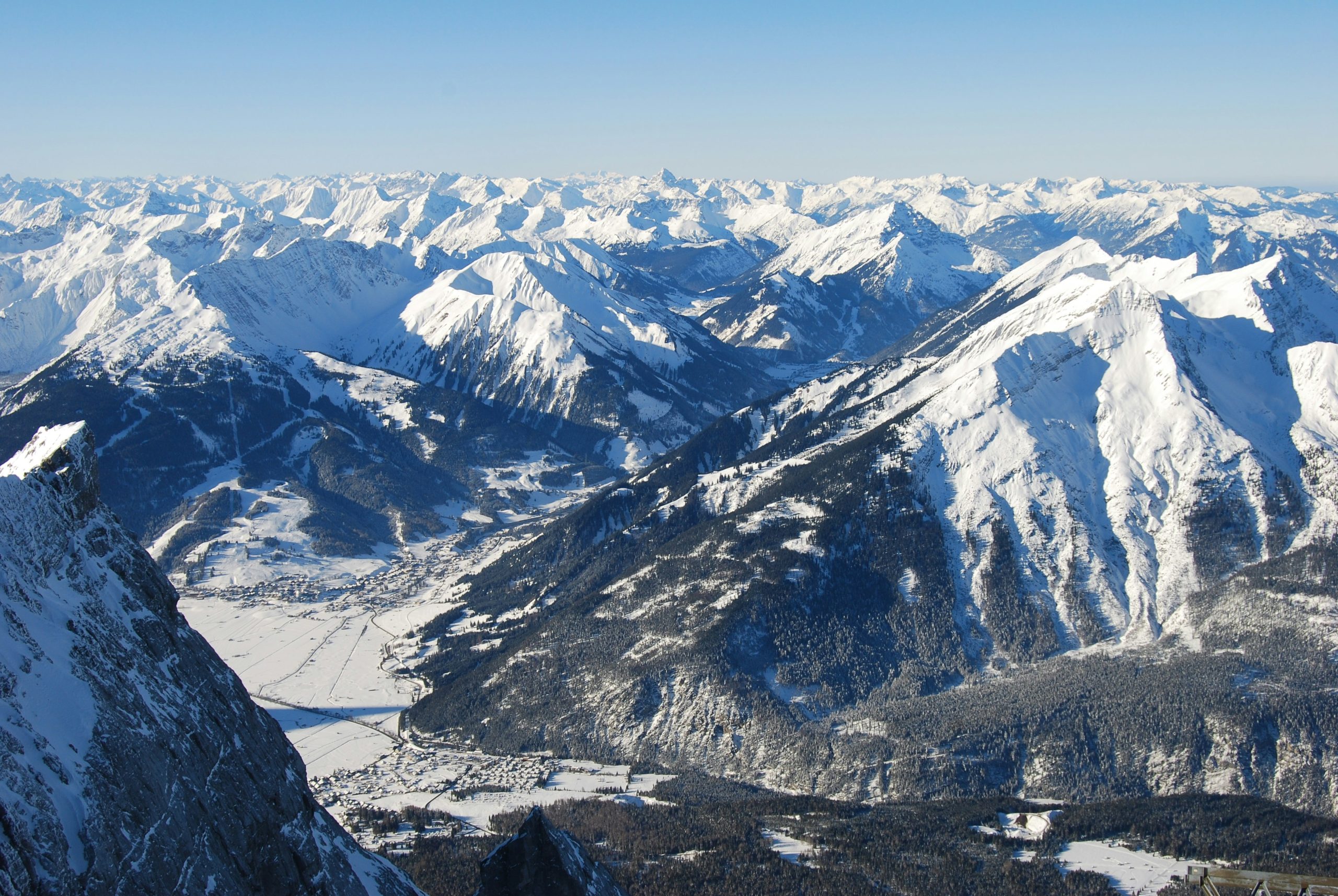
Zugspitze skiing means glacier skiing at Germany’s highest ski area, between roughly 2,720m and 2,962m. It is compact and snow-sure, but its terrain is mostly beginner and intermediate. Garmisch-Classic spans three connected mountains, Alpspitze, Hausberg, and Kreuzeck, between roughly 720m and 2,050m. It has more total piste length, a fuller range of difficulty including genuine black terrain, and a larger resort-town base, but its lower elevation makes it more exposed to warm spells and thin early or late-season snow.
Zugspitze vs. Garmisch-Classic at a Glance
| Feature | Zugspitze | Garmisch-Classic |
|---|---|---|
| Elevation range | About 2,720m to 2,962m | About 720m to 2,050m |
| Lifts | About 9 | About 18 |
| Piste length | About 20km | About 40km |
| Difficulty mix | Mostly beginner and intermediate, little marked black terrain | Beginner, intermediate, and genuine expert terrain |
| Typical season window | Late November to early May, snow and weather dependent | Early December to late March, snow and weather dependent |
| Best for | Guaranteed snow, shorter days, first or last runs of the season | Full ski days, terrain variety, stronger skiers and riders |
| Main weakness or risk | Limited terrain and mileage; cable car and summit skiing exposed to wind and visibility closures | Lower slopes vulnerable to warm spells and thin natural snow, especially in December and late March |
Elevation, lift, and piste figures are drawn from the official Zugspitze and Garmisch-Classic ski area pages and independent resort statistics. Confirm current lift counts and any recent upgrades on the official site before a trip, since infrastructure can change between seasons.
Zugspitze Ski Area: Terrain, Elevation and Snow Reliability
The Zugspitze ski area sits on the Zugspitzplatt glacier, reached by cable car from Eibsee or by the Bayerische Zugspitzbahn cogwheel train from Garmisch-Partenkirchen. Skiing takes place between roughly 2,720m and 2,962m, using around 9 lifts and about 20km of runs.
The terrain mix skews toward beginner and intermediate skiing. There is little marked black terrain. Confident intermediates and advanced skiers can typically ski the full mountain in a morning rather than needing a full day.
Altitude is the main reason to choose Zugspitze. It is the most snow-reliable ski area in Germany, and that reliability matters most at the edges of the season, in December before lower resorts have built a base, and in March or April when lower slopes are turning to spring conditions.
The tradeoff is scale. Zugspitze’s shorter piste length and narrower difficulty range make it a poor fit for a full day of varied skiing. Skiers who want long descents, mogul runs, or black-diamond terrain will find it thin on its own.
Skip Zugspitze on a day when mileage and terrain variety matter more than guaranteed snow, or when low cloud and wind are likely to limit visibility at the summit.
Garmisch-Classic Ski Area: Terrain, Elevation and Snow Reliability
Garmisch-Classic connects three mountains, the Alpspitze, Hausberg, and Kreuzeck, into one ski area between roughly 720m and 2,050m. It has around 18 lifts and about 40km of runs, with a fuller spread of difficulty that includes genuine black and expert terrain, notably around the Hausberg’s Kandahar downhill course.
The lower base elevation is the main limitation. Early and late-season coverage depends more on natural snowfall and temperature than at the Zugspitze, particularly on the lower Hausberg and Kreuzeck sections. A warm spell in December or a mild stretch in late March can leave lower runs patchy while the upper Alpspitze terrain holds up better.
In exchange, Garmisch-Classic offers far more total mileage and terrain variety for a full ski day, plus a resort-town base with more lodging, rental shops, and restaurants close to the lifts than the Zugspitzbahn’s valley station.
Travelers chasing guaranteed snow in a low-snow December or a warm March should not rely on Garmisch-Classic alone during those stretches. Verify current lift and piste counts, and any lift upgrades, on the official Garmisch-Classic ski area page before finalizing plans, since resort infrastructure changes over time.
Which Area Fits Your Ability Level and Group
Beginners and early intermediates generally get more usable terrain and a more developed ski-school setup at Garmisch-Classic. Confident intermediates who want a shorter day with guaranteed snow do well at the Zugspitze. Advanced and expert skiers will usually find Garmisch-Classic’s black terrain more satisfying than the glacier’s mostly blue and red runs.
Families with children in ski school should plan full lesson days at Garmisch-Classic, where meeting points and gentle terrain are more concentrated. The Zugspitze glacier works better as an add-on day with wide mountain views than as a base for a full day of ski-school instruction, since it has fewer beginner-specific facilities.
Mixed-ability groups should not plan to split between the two areas on the same day. They use separate base stations and separate tickets unless a combined product is purchased, so switching mid-day adds a transfer rather than a lift-to-lift connection. Pick one area per day instead.
Zugspitze works best for a group prioritizing a short, snow-sure day with wide mountain views. It works less well for a group that wants a full day of varied terrain or needs extensive beginner infrastructure.
Lift Tickets: Separate Passes and the Combined Options
Zugspitze and Garmisch-Classic are sold as separate day tickets by default, each with its own price. A skier who wants to use both areas on different days of the same trip needs to buy a ticket for each day at the relevant area, or use one of the combined products described below.
The operator, Bayerische Zugspitzbahn, also sells combined products that cover both mountains. For the 2026/2027 season, the officially published winter season pass covering Garmisch-Classic and Zugspitze together costs 661 euros for an adult, with a Garmisch-Classic-and-Wank-only winter pass at 507 euros and a broader regional Top Snow Card at 797 euros. A shorter combined product, sometimes marketed as a two-peak or twin-ticket option, lets a skier use one mountain per day across two days rather than committing to a season.
Single-day adult ticket prices for each area are set closer to the season and were not fully published across every ticket subpage at the time of writing. The most recent published day-ticket range for Garmisch-Classic was roughly 67 to 69 euros for an adult, depending on the exact week. Confirm the current adult day-ticket price for each area, and the current terms of any combined multi-day or season product, on the official zugspitze.de tickets and rates pages before booking, since these figures change from season to season.
For a short trip, buying separate single-day tickets is usually more flexible than a season product. A family that skis both areas repeatedly across a season is more likely to find the combined season pass worthwhile once the per-day cost is compared against buying individual tickets.
Online advance purchase is typically cheaper and reduces time spent in ticket lines compared with buying at the counter, though the exact current discount and any online-only conditions should be confirmed on the official ticket page before relying on it. Day-trippers planning to ski only one of the two mountains do not need a combined product.
Weekday vs. Weekend Crowds at Each Area
Garmisch-Classic tends to draw heavier weekend and Bavarian school-holiday crowds than the glacier, partly because of its larger resort-town base and its direct rail connection from Munich.
The Zugspitze has its own bottleneck risk. Its cable car and cogwheel railway have finite capacity, and clear-weather weekends concentrate demand from sightseers riding to the summit for the views as well as from skiers, which can mean longer queues at the base and mid-station than the skiing alone would suggest.
A practical pattern is to ski Garmisch-Classic on weekdays when possible and treat a clear weekend day as the trigger to go up the Zugspitze early, before midday crowds build at the cable car.
This guidance reflects general seasonal patterns rather than a verified daily statistic. Treat it as a planning habit, not a guaranteed schedule, and expect variation around holidays and major snow events.
Weather and Closure Risk: What Can Shut Down Each Mountain
At the Zugspitze, the cable car and top-station skiing are more exposed to high-wind closures and visibility restrictions than lower resorts, simply because of the summit location. Glacier crevasse and route management can also limit access to some off-piste terrain regardless of how much snow has fallen.
At Garmisch-Classic, the lower sections of the Hausberg and Kreuzeck are more exposed to warm spells and a shifting rain-snow line, especially in December and late March. The higher Alpspitze terrain generally holds up better during marginal stretches.
Check the official current lift-status and piste-report pages for both areas on the morning of the visit rather than relying on seasonal averages. An open resort or lift on a given day does not guarantee full terrain access or stable conditions, particularly for off-piste or higher-altitude sections.
Build in a lower-elevation or indoor backup for a wind-closure day on the glacier. Garmisch’s town center, the Partnachklamm gorge, or a spa afternoon are reasonable fallback options when the cable car is not running.
Choosing Which to Ski First on a Multi-Day Trip
Start with the multi-day forecast rather than a fixed itinerary. Ski Garmisch-Classic on any cloudy, low-visibility, or lower-confidence snow day, since its lower elevation and larger terrain footprint make it the more forgiving choice when conditions are uncertain. Save the Zugspitze for the clearest, calmest day of the trip, since its main appeal, wide summit views and dependable glacier snow, depends on visibility and wind as much as on the season.
For a two-day trip, ski Garmisch-Classic on day one while adjusting to the terrain and conditions, then move to the Zugspitze on day two if the weather cooperates.
For a single day with uncertain weather, default to Garmisch-Classic for the reliability of a full ski day. Treat the Zugspitze as a bonus to add only if the forecast turns clear, not as the core plan.
Late-season trips in March, and low-snow years in December, both favor giving the Zugspitze more priority, since its altitude holds snow when lower slopes are thin or fading. Berge und Bier’s guide to the best time to ski in the Alps covers how December, January, February, and March compare across the wider Alpine region, including school-holiday crowding.
Skip the Zugspitze entirely for a first-time or nervous beginner with limited time. Garmisch-Classic’s larger footprint and more developed ski-school infrastructure will serve that traveler better than a short, high-altitude day on the glacier.
Getting Between the Two Base Areas
Both ski areas are reached from Garmisch-Partenkirchen, but from different base stations. Garmisch-Classic’s lift bases are reachable on foot or by a short local bus ride from central Garmisch. The Zugspitzbahn’s valley station, where the cogwheel train and cable car to the glacier depart, sits at a separate location, so switching between the two areas mid-trip means a short bus ride or drive rather than a lift-connected crossover.
Travelers arriving without a car can reach Garmisch-Partenkirchen directly from Munich by train in about 90 minutes, then use local buses to reach either ski base. Both areas are workable without a rental car for a traveler staying centrally in Garmisch.
A ski trip based in Garmisch-Partenkirchen also pairs naturally with non-ski days.
Berge und Bier’s guide to Neuschwanstein Castle and a few days in the Bavarian Alps covers nearby castle and valley stops for a rest day.
The comparison of Garmisch-Partenkirchen or Ehrwald helps travelers choose between the German and Austrian sides of the mountain.
For travelers still deciding where to base a Bavarian Alps trip, Berchtesgaden or Garmisch-Partenkirchen compares the two most common options.
Confirm current shuttle and bus routes, plus any walking-distance details, against official Garmisch-Partenkirchen tourism information or the zugspitze.de transport pages before finalizing a day plan, since local transit schedules can change between seasons.
Frequently Asked Questions (FAQs)
Sources
- Zugspitze Ski Area, official Bayerische Zugspitzbahn website
- Garmisch-Classic Ski Area, official Bayerische Zugspitzbahn website
- Zugspitze Ski Resort Statistics, OnTheSnow
- Garmisch-Partenkirchen Ski Resort Statistics, OnTheSnow
- Season Tickets and Annual Passes 2026/2027, official Bayerische Zugspitzbahn website
- Garmisch-Classic + Wank Season and Annual Tickets 2026/2027 (PDF), official Bayerische Zugspitzbahn website
- Garmisch-Partenkirchen Ski Pass Prices, Bergfex
- Zugspitze Ski Pass Prices 2026/27, OnTheSnow