Best Family-Friendly Ski Hotels in the Dolomites With Kids
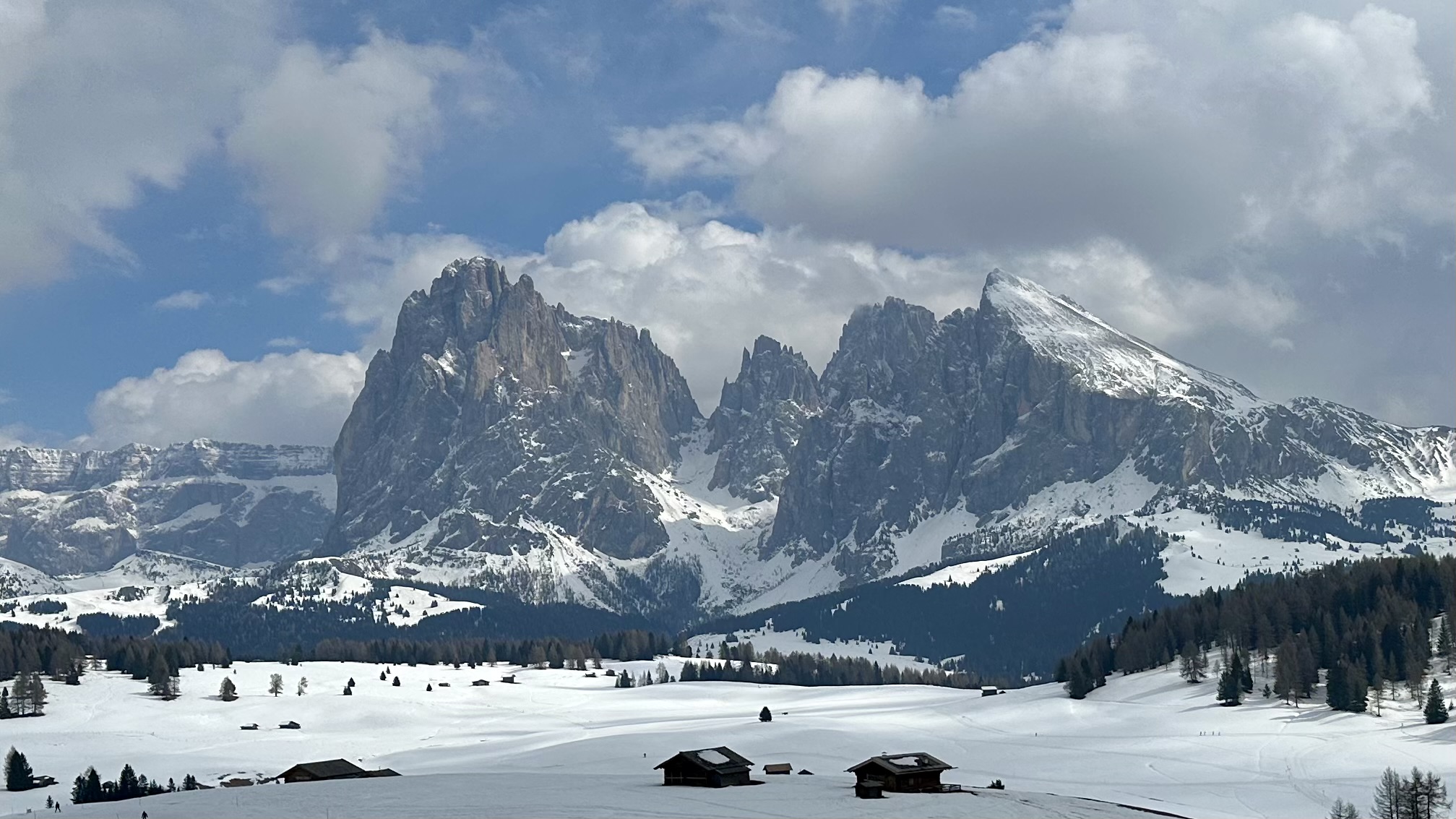
Planning the Dolomites with kids usually comes down to one question: where to put a family with a young beginner-to-intermediate skier who has moved past first turns but is not ready for long, demanding days. Three ski bases answer that question in different ways.
Alpe di Siusi (Seiser Alm) offers the widest and gentlest terrain. Carezza is the smallest and easiest base to move around in. Obereggen has the most purpose-built kids’ ski infrastructure.
None of the three is a luxury ski-in/ski-out destination, and that is the point. All three have real agriturismi and family-run guesthouses alongside their hotels, which matters for a family weighing cost as much as convenience.
This guide is not about skiing the Sellaronda circuit. That is a different trip, built around stronger skiers completing a full multi-valley loop in one day. Where to Stay to Ski the Sellaronda covers that version of a Dolomites ski base.
This guide is about a slower week built around one child’s progression, a manageable ski day, and a lodging choice that does not have to be a big resort hotel.
Pick the ski area first, based on the child’s ability and how much driving the family will tolerate. Then choose between an agriturismo and a hotel based on budget and how much the family wants from breakfast, a pool, or organized childcare. A family that skips the driving question and books lodging first often ends up with a pretty room and an inconvenient ski day.
This guide is not for every family. A child skiing for the first time is usually better served by a single, car-free village built entirely around beginners, such as Kronplatz. A family wanting a true five-star, ski-in/ski-out stay with a higher budget will find Alta Badia a better fit than the budget-conscious bases compared here.
The Dolomites With Kids: What “Family-Friendly” Actually Means
A child who skis blue runs with confidence and is starting to try easier reds does not need a resort built entirely around first-timers. Magic-carpet-only terrain gets boring fast. What this child needs is width: wide, well-groomed pistes with a low penalty for a wobbly turn, so a bad moment does not turn into a fall on a narrow, exposed run.
That is a different resort search than the standard “best beginner ski resort” guide, which usually points toward the smallest, flattest hill available. It is also different from an expert-terrain comparison built around steep pistes and long descents. All three bases in this guide sit in the middle: real ski areas with a strong share of easy and intermediate terrain, not children’s snow gardens.
Ski school is a genuine decision, not a default. Group and private lessons in the Alps are commonly cheaper than equivalent lessons in the United States. What Five Days of Kids’ Ski School Costs in Europe and the US breaks down the specific numbers.
The relevant question here is not cost alone. It is what a family actually wants from the week.
A full day of group lessons builds independence and technical progress faster, and it frees the parents to ski their own terrain. Skiing together as a family, with no formal lessons, keeps the group in the same place all day but caps how fast the child improves. A middle option, a half-day lesson followed by family skiing, works for a lot of groups and is worth asking about at each base’s ski school directly.
Lodging follows the same either/or logic. Agriturismi and family-run guesthouses are usually cheaper, serve home-cooked regional meals, and put the family on or near a working farm rather than in a hotel lobby. They also tend to sit a short drive or shuttle ride from the lift rather than at the base.
Resort hotels cost more and remove that transfer step. The better ones add a kids’ club, a pool, or supervised play space that an agriturismo will not have.
One more thing ties all three bases together: the rock walls of the Sciliar, the Rosengarten and the Latemar are not backdrop scenery to admire from a car window. They are visible from specific lifts and runs in each area, and the sections below point to where.
Three Family Bases at a Glance
None of these three areas is far from the others. All three sit within a compact cluster around Bolzano, in the Val d’Ega and on the plateau above Siusi allo Sciliar and Kastelruth. A family with a rental car can treat a first choice as a starting point rather than a final answer, and switch bases for a day if snow or crowds disappoint.
| Base | Elevation | Piste | Terrain mix | Best for | Typical lodging | Nearest gateway |
|---|---|---|---|---|---|---|
| Alpe di Siusi | 1,227 to 2,220 m | 73 km | 33% easy, 63% intermediate, 4% difficult | Space and the gentlest overall mix | Agriturismo-heavy | Bolzano |
| Carezza | 1,182 to 2,337 m | 40 km | 47% easy, 40% intermediate, 13% difficult | A small, walkable base | Mixed hotel and agriturismo | Bolzano |
| Obereggen/Latemar | 1,540 to 2,388 m | 49 km | 19% beginner, 67% intermediate, 14% expert | Built-for-kids ski school infrastructure | Hotel-heavy, some agriturismi | Bolzano |
Elevation and piste figures come from current resort statistics checked in September 2026. Confirm the current season’s version of each number before booking, since lift counts and open terrain change from year to year.
Alpe di Siusi wins on raw space and the friendliest overall terrain split for a family that wants to ski together as much as apart. Carezza wins on simplicity: less terrain overall, but a small enough area that a family can do several short laps with a child without long lift lines. Obereggen wins on infrastructure built specifically around children’s ski progression, with the highest share of graded intermediate terrain of the three.
Alpe di Siusi: The Widest Terrain and the Big Meadow Setting
Alpe di Siusi is Europe’s largest high-altitude alpine meadow, reached by cable car from Siusi allo Sciliar or by a road that is largely closed to day-visitor traffic in winter. That restriction matters for planning: a family basing itself right on the plateau or in a village nearby should confirm the current-season cable car schedule and any car access rules before arrival, since the closure is designed to keep the meadow from filling with parked cars, not to make the ski area harder to reach.
Once up top, the appeal for a young intermediate skier is straightforward. The pistes are wide, the grades are gentle, and the openness of the meadow keeps a nervous skier from feeling boxed in by trees or narrow chutes. Runs facing the Sciliar and Schlern rock faces put those walls directly in view rather than somewhere off in the distance, which is a real advantage over a resort where the mountain backdrop is only visible from the base.
For lodging, Fiè allo Sciliar and Völs am Schlern sit just below the plateau and offer a genuine spread between farm stays and family hotels. Hotel Emmy, in Völs am Schlern, runs a ski bus that connects to the Alpe di Siusi cable car within minutes and pairs that with a heated children’s pool, a staffed playroom, and half-board meals, which suits a family that wants convenience without a full luxury price tag.
For a lower-cost, more rural option, Fiè allo Sciliar lists several working farm stays, including Garni Trafisölerhof, Gfinkerhof and Runkerhof, each offering apartment-style rooms and direct contact with farm animals rather than a hotel program. Confirm each property’s current distance to the cable car and ski bus schedule directly, since that detail varies by exact address within the village.
The tradeoff is the transfer step itself. A family that wants to walk out the door and onto snow, with no cable car or bus in between, should look at Carezza or Obereggen instead. Families who value space, views, and a quieter overall feel should accept the short transfer as the cost of that setting.
Carezza: The Small, Easy-to-Navigate Base
Carezza sits in the Val d’Ega between Bolzano and the Dolomites’ mountain passes, directly under the Rosengarten and the Latemar, with Lake Carezza a short distance away. The ski area is smaller than the other two in this guide, at 40 km of piste, but it carries the highest share of easy terrain of the three, at 47%.
That combination, small area plus mostly easy terrain, is what makes Carezza work well for a family with one developing skier. Shorter lift lines and a compact layout mean more laps in a morning and less time standing around, which matters more to a six- or eight-year-old than an extra ten kilometers of terrain they will not use anyway.
Hotel Adler Carezza, in Nova Levante, sits at 1,400 meters near the Latemar forest, with the ski area about two kilometers away and reachable by a public bus that stops in front of the hotel. It offers connecting family rooms, a playroom and playground, and a breakfast buffet, and guests receive the regional Südtirol Guest Pass for free local public transport during their stay.
For a farm-stay option nearby, Kronlechnerhof sits about four kilometers from central Nova Levante on a hillside, with apartment-style rooms, homemade farm specialties, and the same regional guest pass included. Confirm current room availability and the exact bus schedule to the lift base directly with each property before booking.
The tradeoff is scale. A child who progresses quickly during the week may start running out of new terrain to try within a few days at Carezza, especially compared with Obereggen’s larger intermediate network. Families expecting to stay more than four or five days, or traveling with a stronger secondary skier in the group, should weigh Obereggen instead.
Obereggen: Built-for-Kids Ski School Infrastructure
The Latemar ski area links Obereggen with Pampeago and Predazzo across the South Tyrol and Trentino border, and Obereggen itself is the most developed and easiest base for a family staying in the Val d’Ega. It carries the largest share of graded intermediate terrain of the three areas at 67%, which is the terrain band a progressing young skier spends the most time in.
Hotel Obereggen, on the pass road through the village, pairs a five-day-a-week Kiddy Club with an integrated working farm, Agriturismo Ortnerhof, so the family gets organized childcare and hands-on farm time in the same stay rather than choosing between them. The property runs on half-board, described on its own site as “Cucina Alpina Half-Board PLUS,” with a breakfast buffet and a set evening menu. The hotel notes proximity to the Latemar and Obereggen ski area and offers ski rental on site, though it does not advertise direct ski-in/ski-out access, so confirm the walking distance to the nearest lift before booking if that detail matters to the family’s plans.
This is the strongest of the three bases for a child who is actively progressing during the trip and benefits from graded terrain to move up through, plus a ski school built specifically around that progression. It is also the plainest to look at of the three: the base area is more purpose-built than Carezza’s setting under the Rosengarten or Alpe di Siusi’s meadow views. A family weighing views as heavily as ski-school logistics should lean toward one of the other two bases instead.
Agriturismo or Resort Hotel: Making the Lodging Call
The tradeoff is consistent across all three bases. Agriturismi and family-run guesthouses cost less per night, include home-cooked regional meals, often on a half-board basis, and put the family in a working farm setting rather than a hotel lobby. They also tend to require a short drive or bus ride to the lift, offer simpler rooms, and will not have a kids’ club or a pool.
Resort hotels cost more. In exchange, they remove the transfer step and add the infrastructure an agriturismo cannot offer: supervised childcare, a heated pool, a playroom, or an on-site ski school desk.
A useful way to decide: choose an agriturismo when the family cares more about cost, home cooking and a quiet rural evening than about convenience. Choose a hotel close to the lift when minimizing daily transfer friction and having built-in kids’ programming matters more than price. A smaller family hotel a short walk from the lift, rather than directly on it, is the common middle ground and worth checking at each base.
The ski school choice from earlier connects directly to this one. A family doing full-day group lessons benefits more from a slope-side hotel, since a shorter midday return matters when a tired child needs lunch and a break. A family skiing together, with only occasional half-day lessons, can more easily accept the short drive from an agriturismo.
Whichever property a family shortlists, verify the current rate for the actual travel dates, the board basis, the real distance to the nearest lift, and whether ski school pickup or a shuttle is offered, directly with the property or a booking platform, immediately before booking. Compare properties using the same date range, occupancy and season so the comparison is fair.
Getting There, Passes and What to Skip
Bolzano is the natural gateway for all three bases, with train and road connections into the Val d’Ega and up toward Siusi allo Sciliar and Kastelruth. A rental car is close to essential for reaching Carezza and Obereggen directly. Alpe di Siusi’s partial cable car and restricted winter road access reduce, but do not eliminate, the need for a car once the family is based nearby, since getting to and from Bolzano still typically requires one.
All three bases sit inside the Dolomiti Superski network, though each falls under a different regional grouping: Alpe di Siusi under Val Gardena/Seiser Alm, Carezza under Val di Fassa/Carezza, and Obereggen under Val di Fiemme/Obereggen. A single-region pass covers only that base’s local terrain, so a family planning to day-trip between two or three of these bases needs the full Dolomiti Superski pass rather than a local one.
On the Dolomiti Superski pass, children born between 2018 and 2022 currently ski free when purchased alongside a full-price adult pass of the same type and duration, or at a 50% discount when bought on its own. That age band shifts by a year each season, so confirm the current rule against the child’s exact birth year before assuming the discount applies.
With a young, still-developing skier, skip the marathon ski day. Skip the Sellaronda circuit itself, which assumes a full day of linked skiing across four valleys. Skip any terrain that requires off-piste or ski-touring equipment.
All three bases in this guide have at least one non-ski option worth checking for a rest day, from natural ice rinks to sledding runs to an indoor pool at the family’s hotel.
Young skiers tire faster than adults. Building in a shorter day, an early lunch, or an afternoon off is more realistic than treating every day as a full session from lift opening to close. That is one more reason the lodging choice matters: a slope-side hotel makes an early return simple, while an agriturismo a short drive away asks a tired family to get back in the car first.
Frequently Asked Questions (FAQs)
Sources
- Alpe di Siusi (Seiser Alm) ski area statistics, skiresort.com
- Carezza ski area statistics, skiresort.com
- Latemar (Obereggen/Pampeago/Predazzo) ski area statistics, skiresort.com
- Hotel Emmy, Völs am Schlern
- Farm stays in Fiè allo Sciliar, including Garni Trafisölerhof, Gfinkerhof and Runkerhof
- Hotel Adler Carezza, Nova Levante
- Kronlechnerhof, Nova Levante
- Hotel Obereggen and Agriturismo Ortnerhof
- Dolomiti Superski ski pass discounts
- Where to Stay to Ski the Sellaronda: Four Ski Bases Compared, Berge und Bier
- What Five Days of Kids’ Ski School Costs in Europe and the US, Berge und Bier