Things to Do in Düsseldorf
Düsseldorf is a city that rewards visitors who look past its reputation as a business capital and fashion hub. Beneath the polished surface is a genuinely varied travel destination: a compact old town with riverside bars and historic churches, one of Germany’s strongest concentrations of modern art, bold post-industrial architecture, and a regional beer culture that locals take seriously.
This guide covers the core things to do in Düsseldorf across a 1–3 day visit. It focuses on central neighborhoods and the most practical choices for first-time and repeat visitors, with day trip options for those staying longer.
Quick overview of the main attractions in Düsseldorf
| Attraction | Type | Neighborhood | Why Visit |
|---|---|---|---|
| Altstadt (Old Town) | Historic district | Altstadt | Densest concentration of bars and classic architecture in the city center |
| Rhine Promenade | Waterfront walk | Altstadt / Carlstadt | Flat, scenic riverside path ideal for orientation walks |
| Königsallee (Kö) | Shopping boulevard | Stadtmitte | One of Germany’s most famous luxury shopping streets, flanked by a canal |
| Kunstsammlung NRW (K20 & K21) | Art museum | Stadtmitte / Ständehausstraße | Strong modern and contemporary collections; Paul Klee holdings among the best in Europe |
| Kunsthalle Düsseldorf | Contemporary art | Grabbeplatz | Smaller, more experimental programming than the Kunstsammlung |
| MedienHafen | Architecture / waterfront | Hafen | Frank Gehry buildings and transformed industrial docklands |
| Schloss Benrath | Palace and gardens | Benrath (south Düsseldorf) | Rococo palace with formal gardens; reachable by tram |
| Carlstadt | Antiques and galleries | Carlstadt | Quieter alternative to Altstadt; good for independent browsing |
| Altbier breweries | Food and drink | Altstadt | Traditional copper-colored beer served directly from wooden casks |
| Cologne or Aachen (day trip) | Day trip | Outside Düsseldorf | Both reachable within 30–45 minutes by train |
Düsseldorf Altstadt: More Than Just a Party District
The Düsseldorf Altstadt is the logical starting point for any visit. It earns its place on every list of things to do in Düsseldorf, and for practical reasons: nearly everything a first-time visitor needs is within walking distance here.
The physical character is compact and mostly pedestrianized. The architecture is a mix of reconstructed historic buildings and lively street-level activity. It does not have the sweeping medieval streetscapes of some German old towns, but it functions well as a base for exploring the wider city.
The Altstadt carries a well-known reputation as the “longest bar in the world.” That description is a local shorthand for the high density of bars concentrated in a small area. The nighttime atmosphere is genuinely lively and, at weekends, loud.
Daytime is a different experience. Visitors can walk through without encountering much of the evening crowd.
Key landmarks within the Altstadt include the Marktplatz, the St. Lambertus Basilica with its distinctive twisted spire, the Schlossturm (the surviving tower of the old castle, now a shipping museum), and the riverfront statues along the Rhine embankment.
Who this works for: First-time visitors and anyone doing a single day in Düsseldorf. The Altstadt gives the most complete sense of the city in the least amount of time.
Who may want to adjust expectations: Travelers specifically seeking quieter, off-the-beaten-track experiences will find the Altstadt’s reputation is largely accurate after dark.
The Rhine Promenade: Düsseldorf’s Best Free Activity
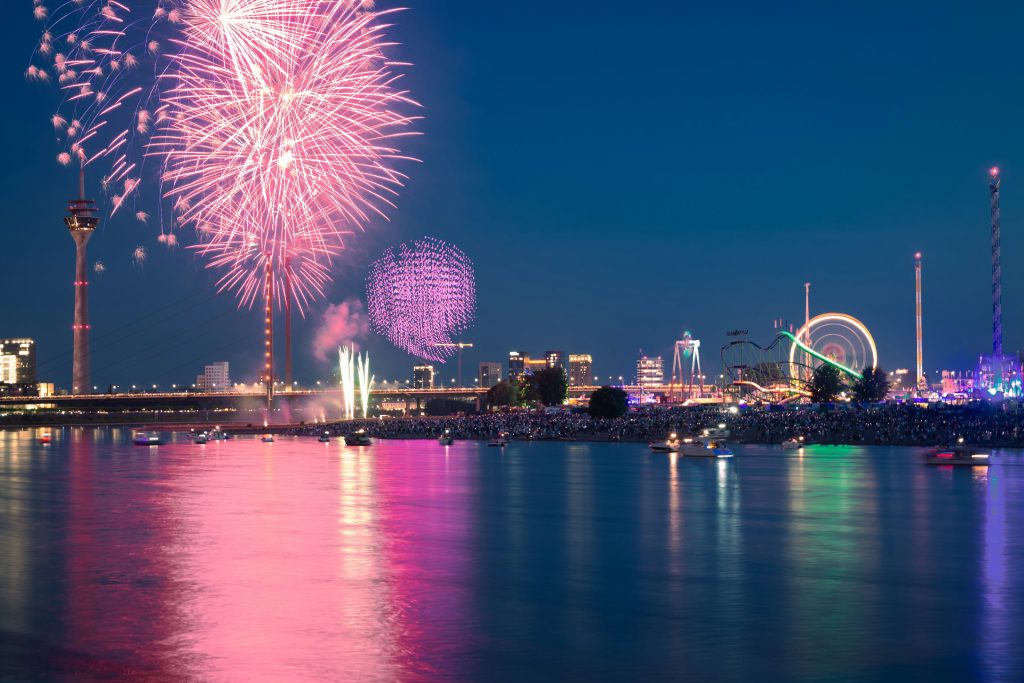
The Rhine Promenade is the most accessible and orienting activity in Düsseldorf. It costs nothing, requires no planning, and connects several of the city’s main areas on foot.
The promenade runs along the west bank of the Rhine, with an elevated path above the river and a lower walkway closer to the water. Walking south from the Altstadt, the path links through to MedienHafen. The walk between the two takes approximately 20–25 minutes at a relaxed pace.
The terrain is flat throughout, making it suitable for most visitors regardless of mobility considerations.
Seasonal differences are worth noting. In summer, outdoor seating appears along much of the route and river activity increases. In winter, the path is quieter but still pleasant for walking, and views across the wide Rhine are clear.
The promenade is also a practical way to understand Düsseldorf’s geography before committing to any specific itinerary. Most visitors find that a single walk along the river clarifies the city’s layout more quickly than a map.
Königsallee: Window Shopping on the Kö
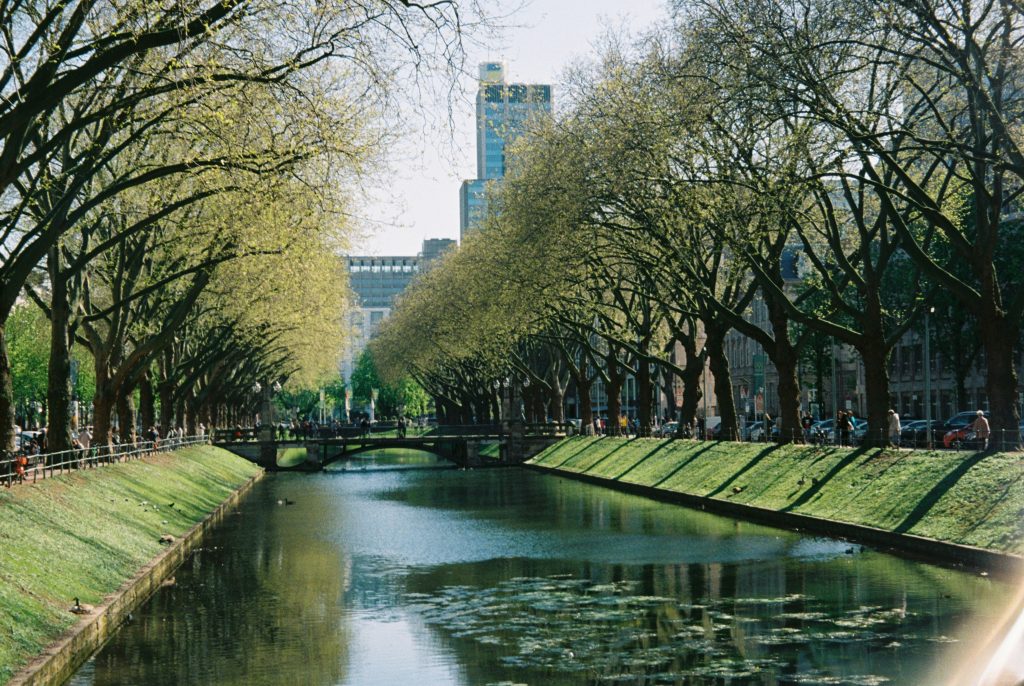
The Königsallee belongs on any list of things to do in Düsseldorf, including for visitors with no interest in shopping. The street itself is an unusual urban space: a wide boulevard split by a narrow canal lined with trees and crossed by small footbridges. The combination of water, avenue planting, and architecture makes it worth a short detour on its own terms.
What the Kö actually offers commercially is high-end international brands, several upmarket department stores, and expensive dining. It is not a destination for budget shopping.
For visitors interested in urban design or German retail culture: the Königsallee is genuinely rewarding.
For visitors on tight budgets or focused on history and art: it can reasonably be skipped or treated as a brief walk-through.
Practically, the Kö sits 5–10 minutes on foot from the Altstadt. Visitors coming from the north can combine it naturally with a walk through the Hofgarten park, which borders the Königsallee at its northern end.
Düsseldorf’s Art Museums: A Serious Cultural Scene
Düsseldorf has one of the strongest concentrations of modern and contemporary art in Germany. This is not an incidental claim. The city’s history as the center of the Düsseldorf School of photography, its connection to figures like Joseph Beuys and Gerhard Richter, and the quality of the Kunstsammlung NRW holdings place it in a different category from most comparable German cities.
K20 (Grabbeplatz)
K20 holds the Kunstsammlung NRW’s 20th-century collection. The Paul Klee holdings are among the most significant in Europe, and the collection extends broadly across early modern European art. Of the two Kunstsammlung buildings, K20 is generally the more accessible starting point for visitors without a specific prior interest in post-1980 contemporary work.
K21 (Ständehausstraße)
K21 focuses on contemporary art from roughly 1980 onward. The building itself is a converted 19th-century parliament and worth attention as an architectural conversion. The collection tends toward installation and conceptual work. It suits visitors with an existing engagement with contemporary practice.
Kunsthalle Düsseldorf
The Kunsthalle sits on Grabbeplatz, the same square as K20. It is a smaller institution with rotating exhibitions that lean toward experimental and emerging work. Entry is typically free or low-cost depending on the current show.
K20 and the Kunsthalle share a square, making them a natural combined visit. K21 is a 10-minute walk south. A full visit to both Kunstsammlung buildings realistically takes most of a day.
Who benefits most: travelers with a specific interest in 20th-century art, photography, or contemporary practice. For visitors on a single-day trip with broader sightseeing goals, one building is the more practical choice.
MedienHafen: Industrial Past, Architectural Present
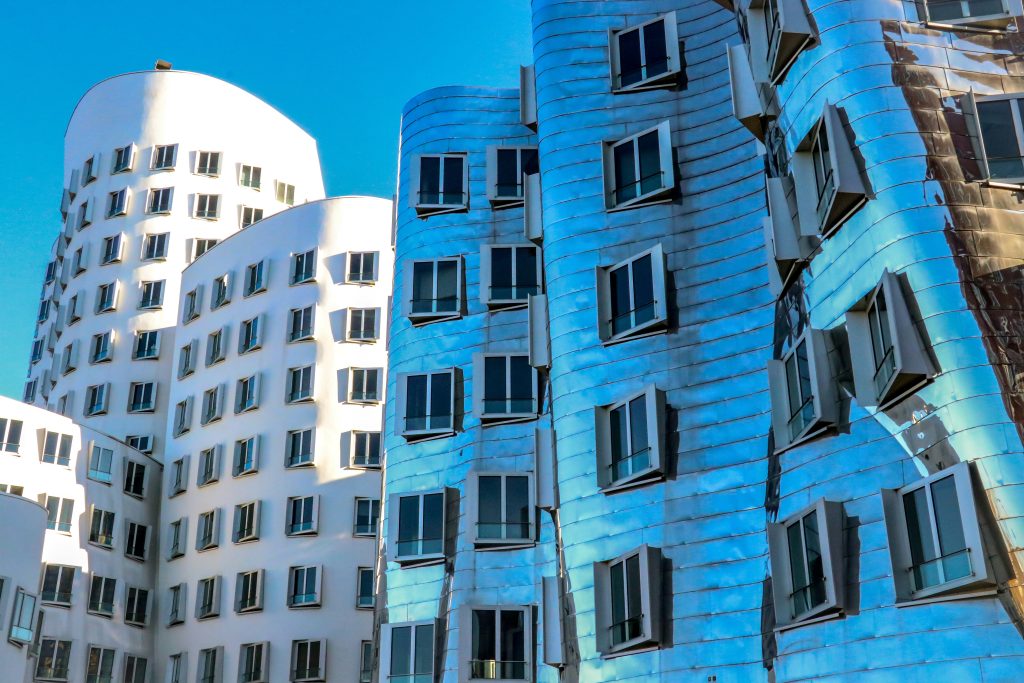
MedienHafen is Düsseldorf’s former commercial harbor, redeveloped since the 1990s into a district of architecture-focused office buildings and waterfront restaurants. The development sits south of the city center, linked to the Altstadt by the Rhine Promenade.
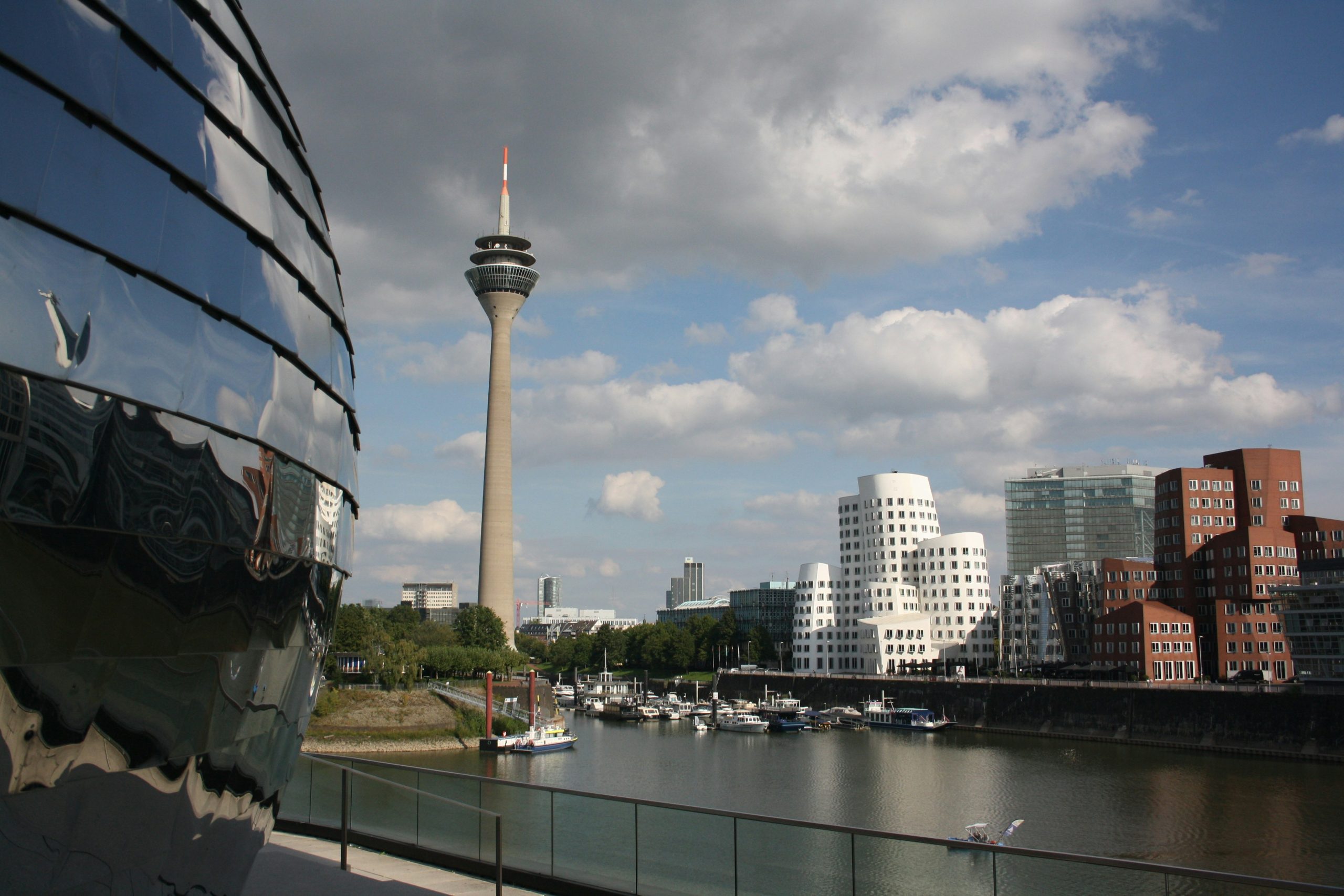
The headline draw is the Neuer Zollhof complex: three tilting, irregular towers designed by Frank Gehry. They are among the most photographed pieces of architecture in the city and represent the kind of signature statement that defined regeneration projects of the 1990s across Europe.
MedienHafen is primarily a working business district. That is the main thing visitors should understand before making the walk.
For visitors interested in contemporary architecture or urban regeneration: it delivers a clear and walkable example of that genre.
For visitors hoping for atmosphere, activity, or a lively evening district: the harbor is quieter than the Altstadt and functions mainly as a daytime destination, though a number of waterfront restaurants are worth noting.
The core architectural area can be covered in under an hour. Combining MedienHafen with the Rhine Promenade walk and a lunch stop at the waterfront makes for a coherent half-day loop from the Altstadt.
Schloss Benrath: A Half-Day Outside the City Centre
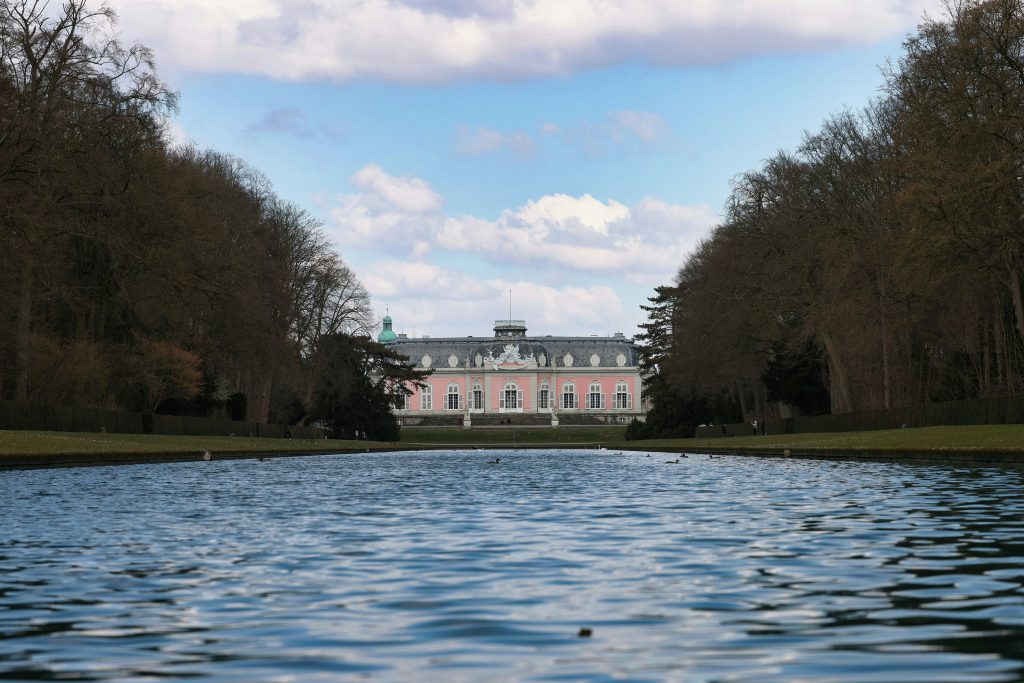
Schloss Benrath is the strongest reason to venture beyond Düsseldorf’s central districts. For visitors staying more than one full day, it is the most obvious answer to what to do next.
The palace is a late Baroque and Rococo ensemble built in the 1750s as a summer residence for the Elector Palatine. The building is compact by the standards of German palatial architecture, but it is carefully proportioned and architecturally refined in a way that larger, more famous palaces sometimes are not.
The formal gardens are the equal of the palace itself. They suit visitors who want to combine culture with a slow outdoor walk. The gardens are free to enter; the palace interior requires a ticket.
Schloss Benrath sits in the Benrath district in southern Düsseldorf. Tram line 701 reaches it from the city center in approximately 30 minutes. The trip adds no meaningful logistical burden for visitors already using public transport.
Best suited for: visitors with two or more days in Düsseldorf, families, and anyone with an interest in architecture or garden history. Less relevant for visitors on a single short day.
Altbier: What to Drink and Where to Drink It
Altbier is as central to Düsseldorf’s identity as Kölsch is to Cologne. The two cities maintain a well-known rivalry, and the beer is part of it. Altbier is not simply a local preference: it is a regional identity marker, and understanding it gives visitors a useful lens on the city’s culture.
The beer itself is a top-fermented, copper-colored ale. It is moderately bitter, slightly darker and more complex than Kölsch, and served in small 0.2-litre glasses called Stangen. The small serving size keeps the beer fresh and cold throughout the drink.
The traditional brewery pubs, known as Hausbrauereien, worth visiting in and around the Altstadt are:
- Uerige — the most famous, brews on-site, typically busy; the standard recommendation for first-time visitors
- Schumacher — slightly quieter, good for a more relaxed visit
- Zum Schlüssel — central location, reliable quality
- Füchschen — slightly south of the main Altstadt cluster; often described as the less touristy option
One service custom is worth explaining in advance: in traditional Altbier pubs, a fresh glass is brought automatically until the drinker places a coaster on top of their glass. This signals that no further rounds are wanted. First-time visitors who are not expecting this sometimes end up with more glasses than intended.
Altbier drinking is most natural as an evening activity, but most Hausbrauereien are open from midday.
Day Trips from Düsseldorf: Two Worthwhile Options
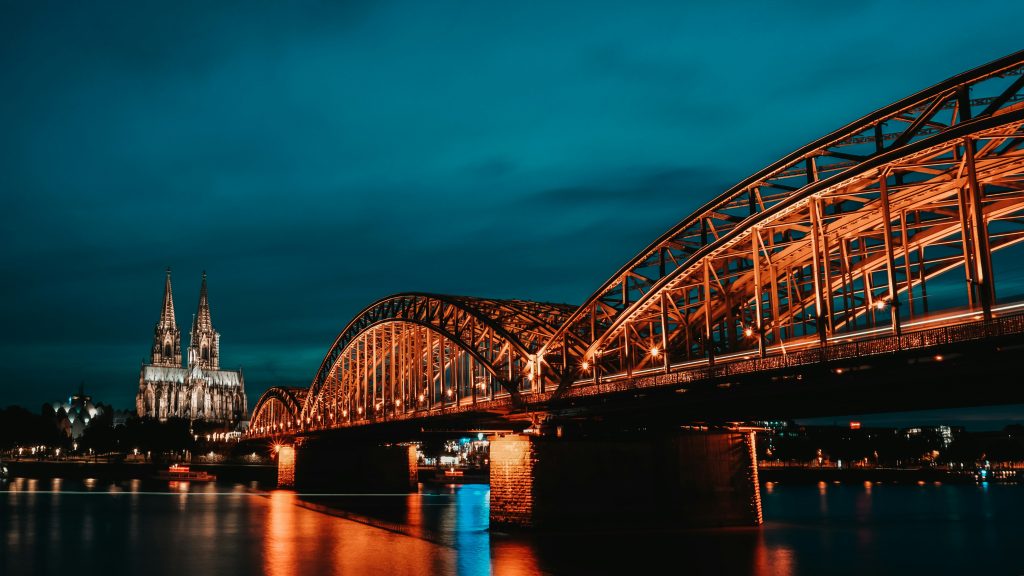
Visitors staying two to three nights in Düsseldorf have easy access to two cities worth including in a broader Rhine region itinerary.
Cologne (Köln): Reachable in approximately 30 minutes by regional train (RE or RB services from Düsseldorf Hauptbahnhof). The Cologne Cathedral, the Roman-Germanic Museum, and the Rhine waterfront together make for a full day. The Altbier vs. Kölsch rivalry is worth knowing as a piece of local context: ordering an Altbier in Cologne or a Kölsch in Düsseldorf is considered a minor provocation by locals on both sides.
Aachen: Around 45–60 minutes by train. Suited to visitors with an interest in early medieval European history. Charlemagne’s palace chapel and the Aachen Cathedral treasury are the primary draws. The city is smaller and quieter than Cologne, making it a more considered choice rather than an obvious one. For repeat visitors to the region or those with a specific historical interest, it is genuinely rewarding.
Both cities work as half-day or full-day trips. Cologne is the right call for first-time visitors to the region. Aachen suits repeat visitors or travelers with a specific interest in Carolingian history.
Xanten, with its Roman archaeological park, is a third option for visitors with a car or an extra day and a strong interest in Roman history.
Planning Your Visit: Timing, Getting Around, and Realistic Itineraries
Best time to visit: Late spring (May–June) and early autumn (September–October) offer the best balance of weather and manageable crowds. July and August are warm but busy. The Christmas market season (late November through December) draws significant visitor numbers and is worth planning around if winter travel is on the table.
How many days: Two full days covers the Altstadt, Rhine Promenade, MedienHafen, and one or two museums at a comfortable pace. Three days allows for Schloss Benrath and a full day trip. One day is workable but requires clear prioritization: the Altstadt and Rhine Promenade first, with one other item depending on interest.
Getting around: The city center is genuinely walkable. The tram and U-Bahn network, run by Rheinbahn, covers outer areas including Benrath efficiently. Cycling infrastructure is solid for visitors who prefer it.
Logistics note: Düsseldorf Airport connects directly to the Hauptbahnhof by S-Bahn in approximately 12 minutes. The Hauptbahnhof is also an ICE hub with fast connections to Cologne, Frankfurt, and Amsterdam, making Düsseldorf a practical base for a wider Germany or Benelux itinerary.